


Monteverde Cloud Forest Reserve
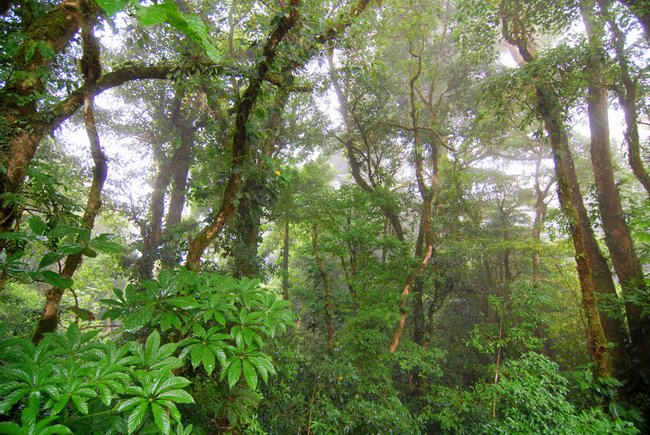
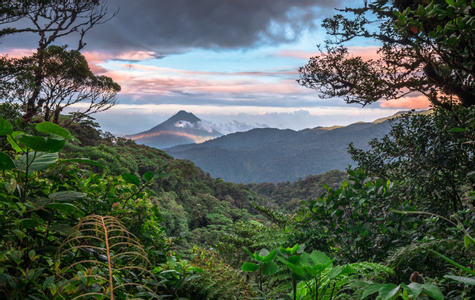
The Monteverde Cloud Forest Reserve (Reserva Biologica del Bosque Nuboso de Monteverde) is where some of the best-kept cloud forest in all of Costa Rica can be found. It is a cloud forest, not a rain forest, due to its elevation of 4,724 ft (1,440 m) above sea level. Some of the best bird-watching can be done inside and outside the reserve.
Plan my TripPlanned with a local insider, takes just 2 minutes.
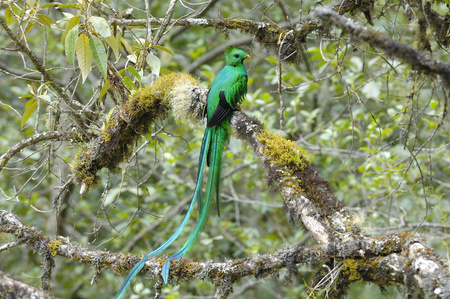
The Monteverde Reserve is one of the best places to see the resplendent quetzal, as it migrates to the lower portions of the park during mating season. The endangered three-wattled bellbird is another member of the 400 species of birds found here, including close to 30 species of hummingbirds. More than 100 species of mammals live in the park, including howler and capuchin monkeys, all five species of cats, deer, tapir and sloths. A total of 1,200 species of amphibians and reptiles live in the reserve, including venomous and non-venomous snakes, frogs and toads. The fabled Golden toad was discovered here but hasn't been seen since 1988.
Along with the mega-diversity of wildlife, there are 2,500 species of plants, 420 of which are orchids. Don't forget the tens of thousands of insects and 5,000 species of moths found inside the reserve. All eight distinct life zones encompass 25,730 acres (10,400 ha) of protected land from high atop the continental divide. The reserve is overseen by the Tropical Science Center of Costa Rica which manages the trails and limits the amount of visitors. The unbelievable biodiversity found in Monteverde has given it international acclaim as one of the most exceptional refuges in the entire world.
When you visit the Monteverde Reserve, you'll probably stay in the bustling town of Santa Elena. Founded in 1951 by a group of Quakers fleeing the United States draft, Santa Elena was the elected area to begin a settlement which soon brought conservation thereafter. Bordering the reserve, the town has plenty of restaurants, lodging, a bank and even its own cheese factory, supplying top quality cheese to the entire country. The quiet tourist community provides a great launching point to discover the area nearby.
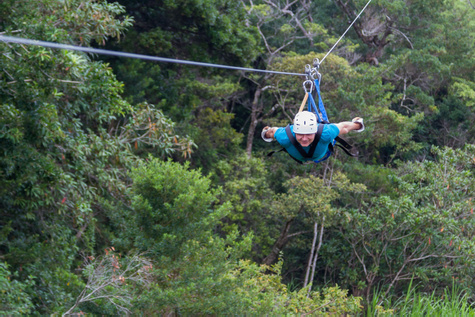
Well-maintained, yet muddy trails are found within all the nature reserves. There are even suspension bridges, canopy tours and zip-lines to let you experience Costa Rica like never before. Numerous companies in Santa Elena offer tours and excursions, so be sure to check it out. The exciting community even has a serpentarium, frog pond, bat jungle, butterfly garden and horseback tours for some pretty amazing up-close wildlife viewing.
The bone-shattering dirt road leading up to Santa Elena from the Pan-American Hwy provides gorgeous views of verdant rolling hills and on a clear day, the Nicoya Gulf. The area is constantly damp as the sweeping clouds rise up the Pacific and Caribbean slopes blanketing the area in moisture.
To access Santa Elena from Liberia, head south along the Pan-American Hwy until the turnoff for Hwy 145. The steep, rugged road will lead you to Santa Elena, making the total trip approximately 70 miles (112 km). From San Jose, head northwest along the Pan-American Hwy until the intersection with Hwy 145. Santa Elena is located 96 miles (155 km) from the nation's capital. La Fortuna is 22 miles (35 km) northeast of Santa Elena. The city of Puntarenas is located 50 miles (80 km) to the southwest.
Does the Cloud Forest Reserve in Monteverde, Costa Rica Limit the Number of Visitors?
The Monteverde Reserve caps the number of people allowed inside the reserve at 450 people per day. However, there cannot be more than 250 people inside the reserve exploring the trails at any one point during the day. The Monteverde Reserve receives thousands of visitors annually and these measures are intended to help sustain the natural habitat for many years to come. The Monteverde Reserve opens at 7 AM and closes at 4 PM every day of the year.
Does Monteverde Reserve Guided Tours Include Entrance Fees?
When you book a private guided tour or a regular guided tour the entrance fee is included. There are, however, strict limits on the number of entrances to the Monteverde Reserve (described above) which are outside of our control.
The best way to ensure your entrance is to arrive at the time of your scheduled tour or private tour. In some cases during peak entrance periods there is a short wait before the tour begins inside the reserve, but there is still plenty of nature to view just outside of the reserve. During peak season it is common for the guides to do some exploring around the entrance of the reserve for a few minutes until the trails near the entrance clear up.
How Do I Find My Guide at Monteverde or Santa Elena Reserve in Costa Rica?
When you book a tour we'll give you information about when and where to meet your guide. Most tours include round-trip transportation from your hotel. The guide will pick you up from your hotel and will accompany you throughout the entire tour.
Wildlife Sightings
Spotted at Monteverde Cloud Forest Reserve
Coati
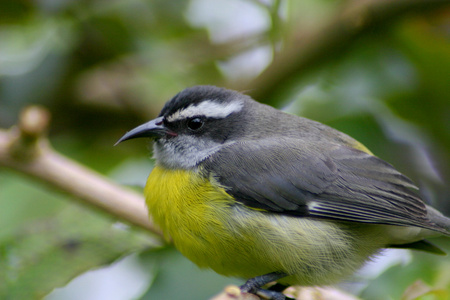
Bananaquit
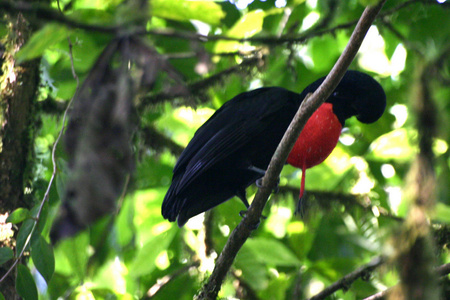
Bare-necked Umbrellabird
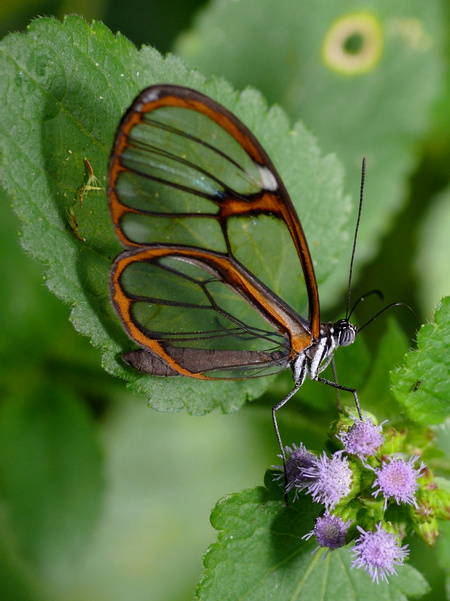
Glasswing Butterfly
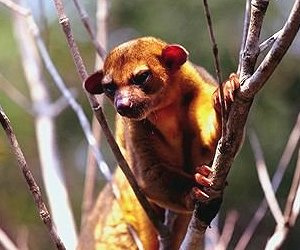
Kinkajou
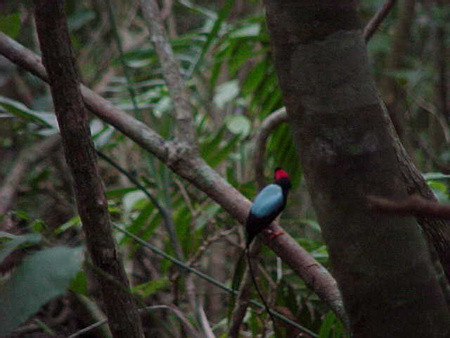
Long-tailed Manakin
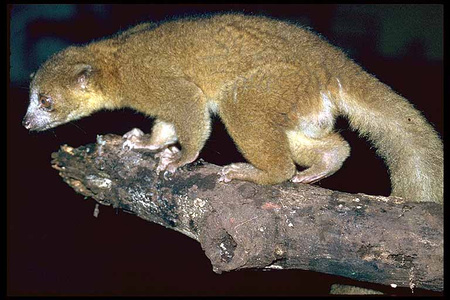
Olingo
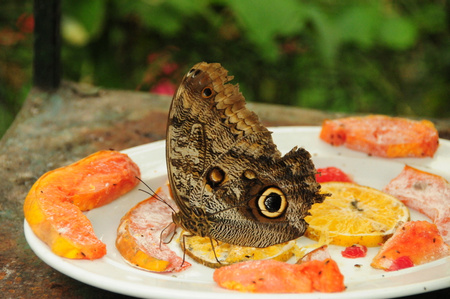
Owl Butterfly
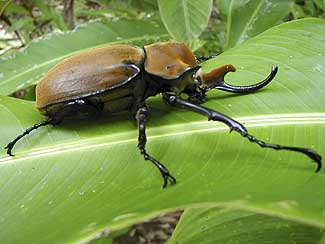
Rhinoceros Beetle
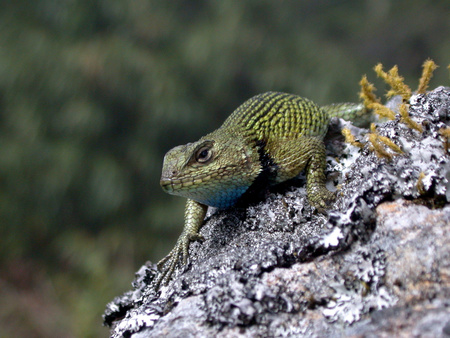
Spiny Green Lizard
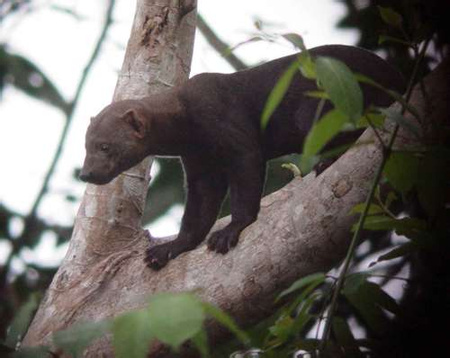
Tayra
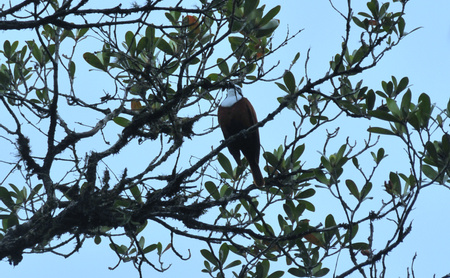
Three-wattled Bellbird
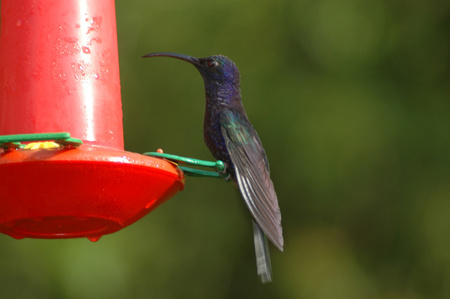
Violet Sabrewing
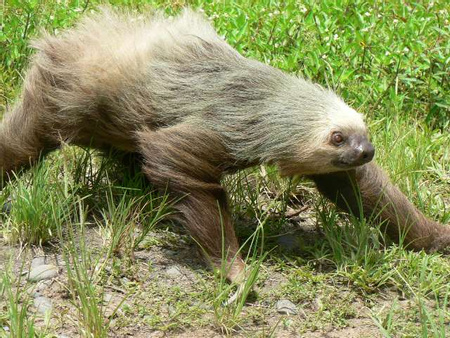
Sloths
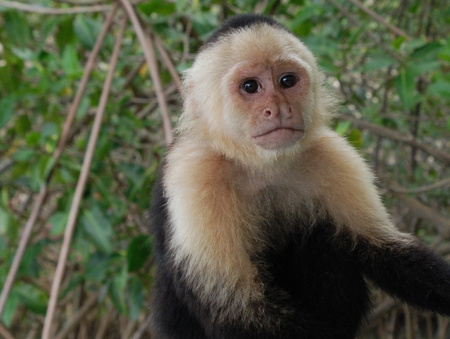
White-faced capuchin monkey

Humpback whale

Sea turtles
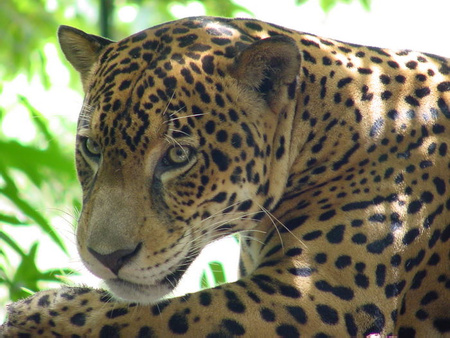
Jaguar
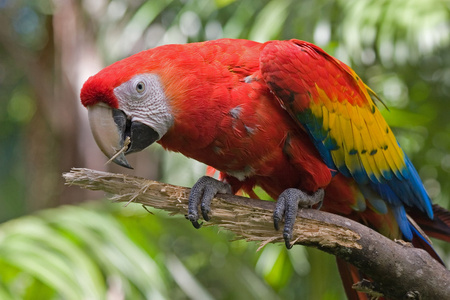
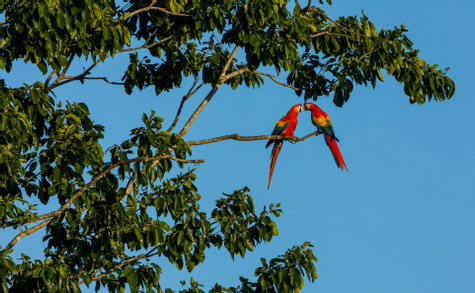
Scarlet macaw
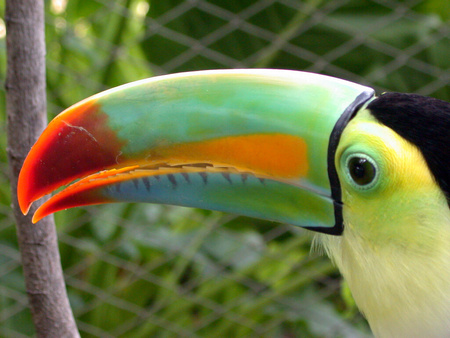
Keel-billed toucan
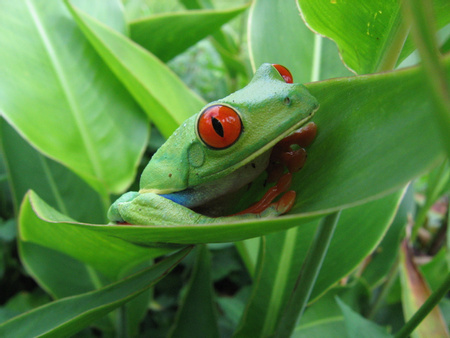
Red-eyed tree frog
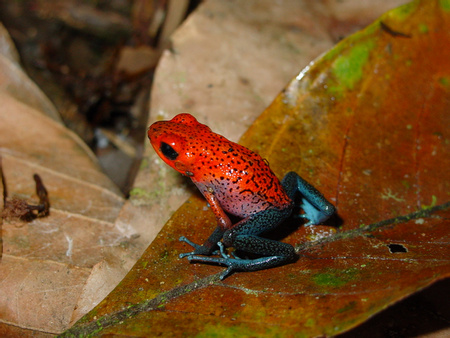
Blue jeans frog

Howler monkey
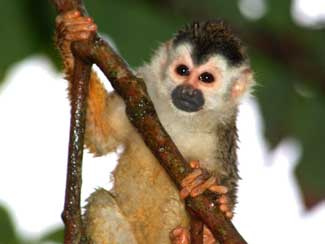
Squirrel monkey
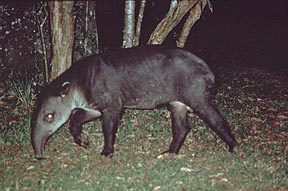
Baird's tapir
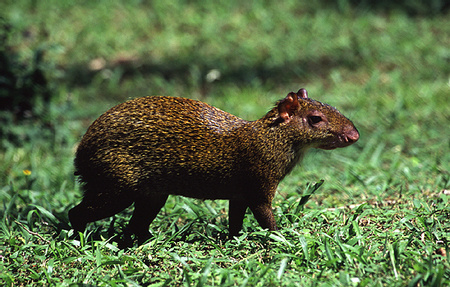
Agouti
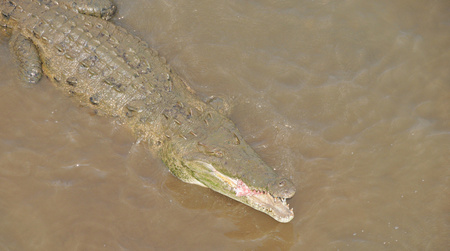
American crocodile
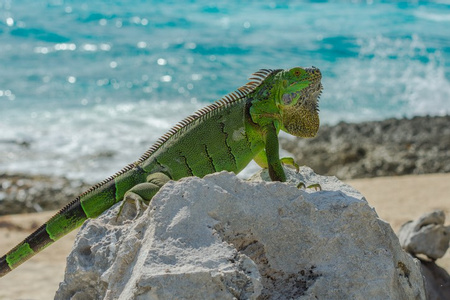
Green iguana
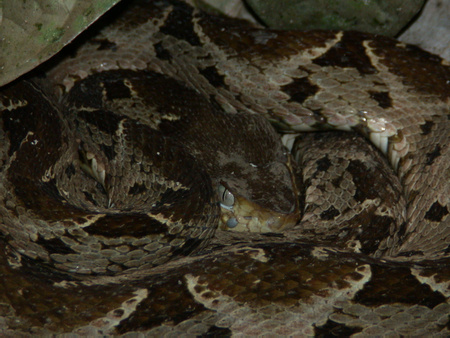
Fer-de-lance
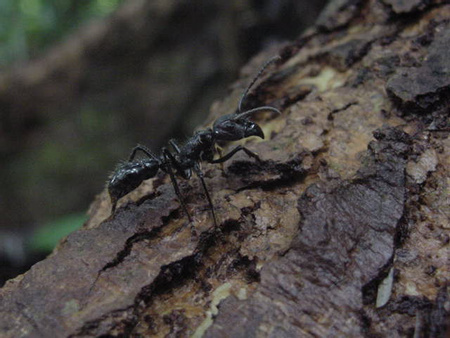
Bullet ant
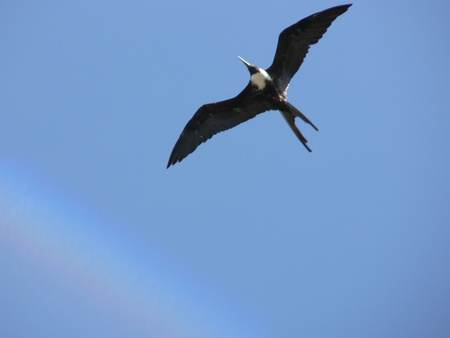
Magnificent frigatebird
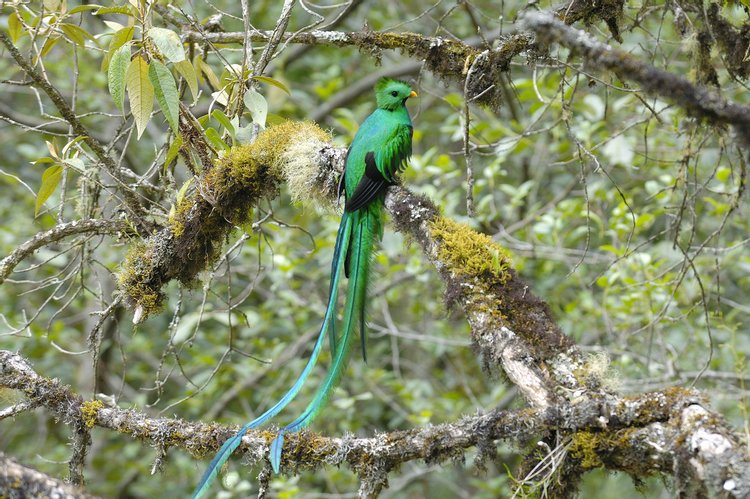
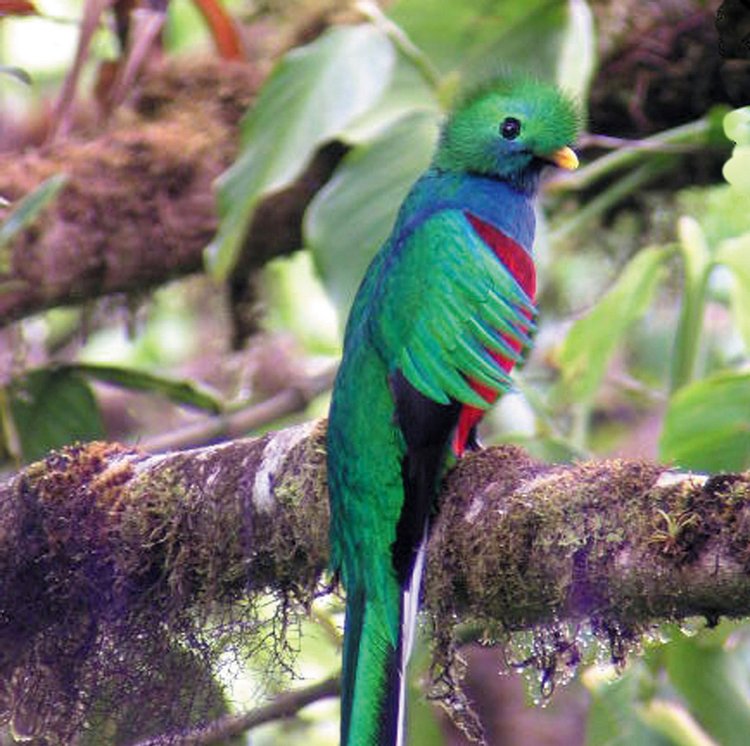
Resplendent Quetzal
Attractive, impressive, richly colorful—this bird lives up to its name. Resplendent Quetzal (Pharomachrus mocinno). Spanish name: Quetzal (ket-saal’).
Habitat
The Quetzal prefers damp mountain forests, and is most active in the canopy and edges; it may survive in heavily deforested areas, but only if there remain woods with adequate feeding and nesting trees.
Range
This bird persists from southern Mexico to western Panama, at elevations between 1,500 and 2,500 m.
Physical Description/Interesting Biology
With stunning, inimitable plumage and grace, the Quetzal is named for its splendor. The Aztec word, quetzalli, was used for this bird's tail feathers, and also meant "precious,' or "beautiful.' This shy trogon is the national bird of Guatemala, and is also popular in Costa Rica. In every part of its range, this bird is endangered because the cloud forest on which it depends has been extensively destroyed.
Alone, in pairs, or in a small flock after breeding, the Quetzal forages in fruiting tries, sallying to snatch fruits or very small animals before returning to the nest. They sing with distinctly smooth, deep, melodious calls that may echo far through the forest. They are usually in the canopy, but during courtship the male may chase the female lower and through the forest. In another impressive courting display, the male spirals high above the canopy before plunging back to the female in the canopy, his long tail feathers rippling behind him.
These legendary tail feathers that can be a meter long are one of the salient traits of the male Resplendent Quetzal. Adult Quetzals have a grey and black striped tail, and are covered in shimmering green on the head, back, and wings, so they blend into the wet foliage of the cloud forest. The females have somewhat similar plumage, but lack the green crest and bright red breast of the males, as well as the elongated tail feathers.
The parents work together to carve nest holes out of decaying trunks or they enlarge holes made by woodpeckers, toucans, or other animals. They depend on finding dead wood because their beaks and claws cannot penetrate live wood. The pair shares the work of incubating the 2 eggs and later feeding the chicks, as well as defending the territory around the nesting tree.
Finding sufficient nesting trees is the main direct limitation on Quetzal survival. It is naturally difficult for them to find trees with wood soft enough for nest excavation, because such trees usually decay before falling. Habitat destruction compounds the challenge to find nesting sites. Humans in Central America are devastating cloud forest area for timber, charcoal, cattle pasture, agriculture, or shifting slash-and-burn agriculture by native farmers. There are already reserves in Costa Rica and Guatemala in which the Quetzal still survives, but if the Resplendent Quetzal is to endure, it would be most beneficial to have a system of cloud forest parks from Mexico through Panama.
Diet
The Quetzal mostly eats fruits of the avocado family, as well as figs. Its diet also includes insects, small frogs, snails, and lizards. It drinks water from the bases of bromeliads.
Height/Weight
This bird as an adult weighs 210 g and has a body 36 cm long; the male's tail streamers may add up to 64 cm.
Brief Taxonomy
Order: Trogoniformes
Family: Trogonidae
Sources
A. LaBastille in: Janzen, Daniel H. Costa Rican Natural History. Chicago: University of Chicago Press, 1983.
Skutch, Alexander F. and F. Gary Stiles. A Guide to the Birds of Costa Rica. Utica: Cornell University Press, 1989.
-Amy Strieter, Wildlife Writer
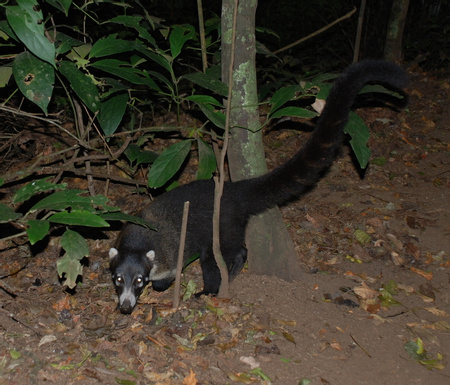
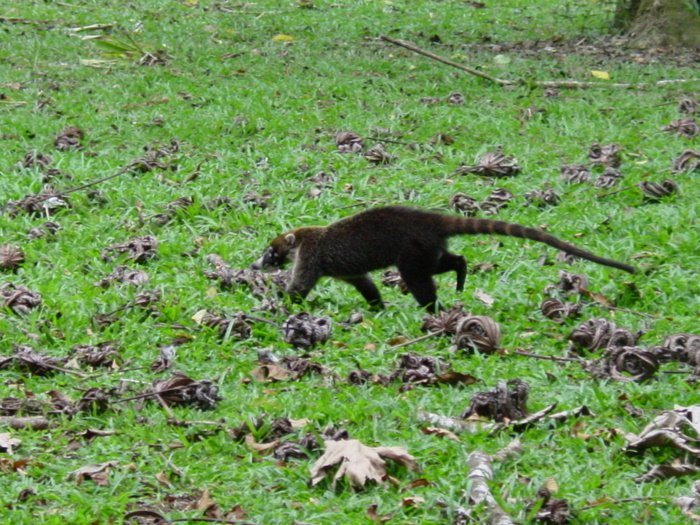
Coati
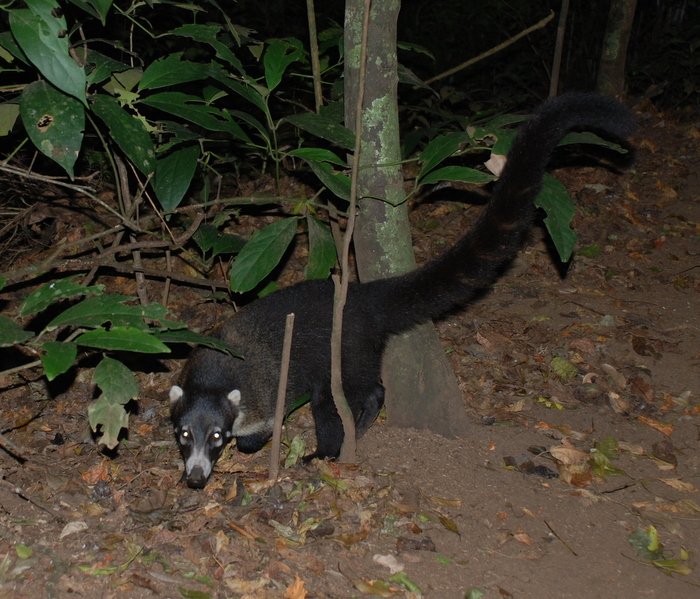
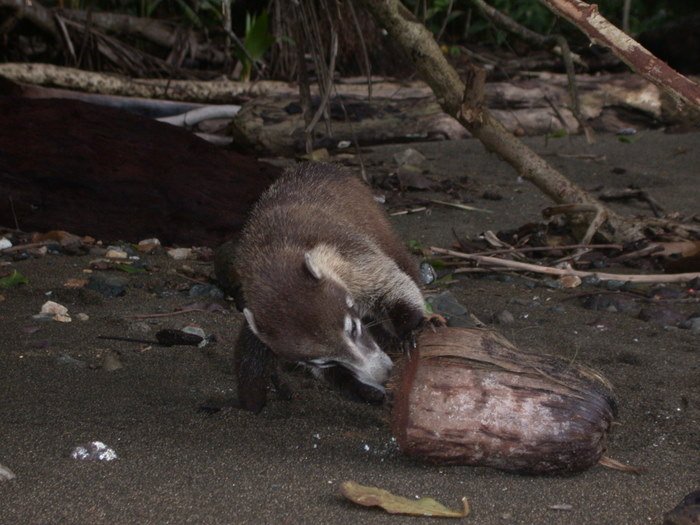
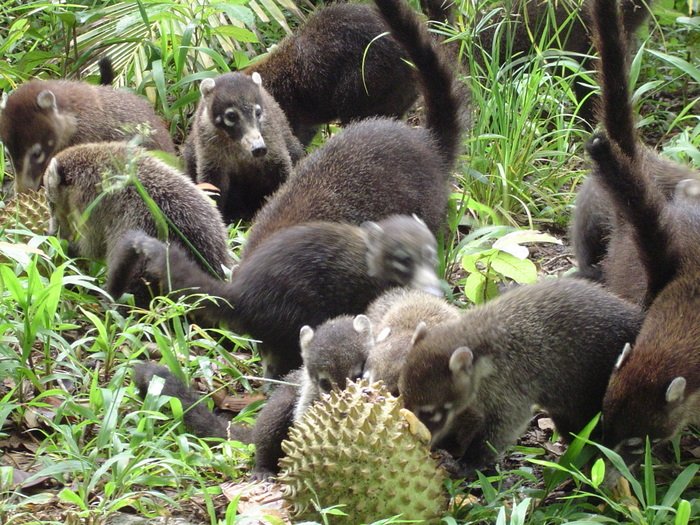
Coati (Nasua narica). Spanish name: Pizote
Habitat
Within its range, the coati can survive in any wooded habitat at elevations of up to 3,000 m. The coati lives in a range of forests, from temperate oak and pine forests to deciduous and lowland tropical rain forests. It is even sometimes seen in deserts and savannas.
Range
Southwestern Arizona through Panama and Columbia to Argentina.
Physical Description
This mammal is distinct with its long mobile snout and faintly ringed tail which is nearly as long as the rest of its body and often carried erect. The body is colored pale to dark brown or reddish or yellowish and the tail banded yellow and brown, with white snout tip and shoulders. Its eyes are ringed with a reddish or brown mask, similar in pattern to the raccoon. Coloration of an individual may change from molt to molt, regardless of sex or age.
Biology and Natural History
The coati is the most diurnal and social member of the raccoon family. It is also impressively flexible and opportunistic in its behavior, and widely adaptive in its geographic range and repertoire of viable habitats.
Comfortable and agile in the tree tops as well as on the ground, the coati uses large, strong claws to access different levels of forest. Impressively acrobatic, it can climb down trees headfirst, pass from tree to tree on small branches high off the ground, and even walk upside down hanging from lianas. Its tail is not prehensile but helps balance during climbing. Coatis sleep in trees at night, unless they are hunted in their area by humans, in which case they become more nocturnal.
Coati social structure changes throughout the year. Several family units of females and their offspring collect in bands of 4-30 coatis. Males under the age of two years may also be in the band. Adult males are solitary except during the breeding season, when a single male will join a band of females and occupy a subordinate position for the entire breeding season. They mate in trees or on the ground. A few days before the young are born, the pregnant females separate from the group individually and build nests in trees. The newborns stay there 5 weeks, while the mother tends to them and forages solitarily. Once they are able to keep up with the adults, they come down from the nest and the band regroups. Band members may groom each other, but they also compete for food.
Adult coatis have few predators (aside from humans), but young ones are targets for boas, raptors, cats, and tayras.
Diet
The coati diet is richly omnivorous and opportunistic, comprised of whatever fruits and prey are available in their area, and adjusting with season. They may sniff out invertebrates under the forest litter like insects, spiders, millipedes, or snails, or catch lizards, mice, or other vertebrates of similar size. They also eat fruit when it is abundant. They can use their strong front claws to destroy rotten logs and stumps looking for food, and pursue lizards and tarantulas from burrows that may be up to 1 m deep.
Height/Weight
Adult males generally weigh 6 kg, and are 1.1 to 1.2 m long with a tail 0.500 to 0.6 m long; females are smaller.
Taxonomy
Order: Carnivora
Family: Procyonidae
Sources
Eisenberg, John. Mammals of the Neotropics, Vol. 1. The University of Chicago Press: Chicago, 1989.
Kaufmann, J. H. in Janzen, Daniel H. Costa Rican Natural History. Chicago: University of Chicago Press, 1983.
Wilson, D. E. in Janzen, Daniel H. Costa Rican Natural History. Chicago: University of Chicago Press, 1983.
-Amy Strieter, Wildlife Writer
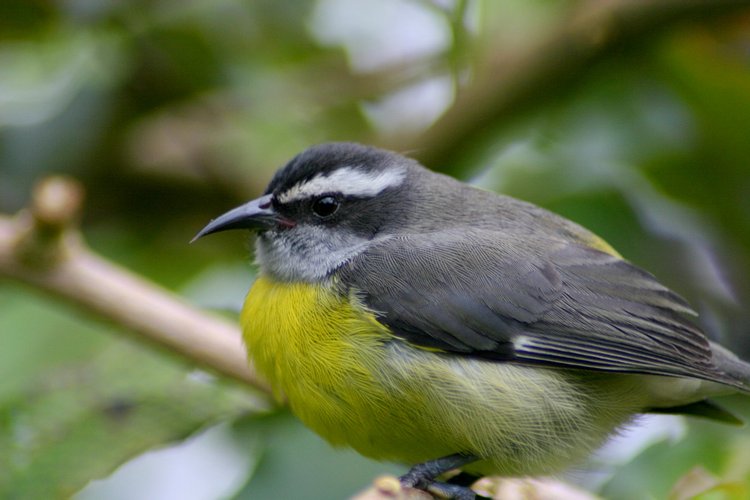
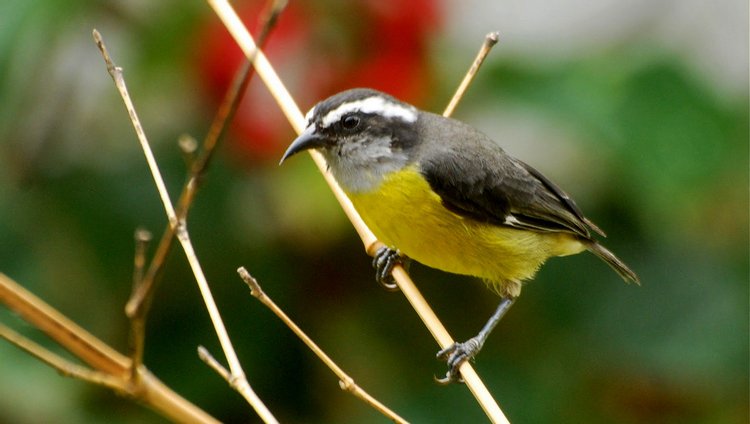
Bananaquit
Bananaquit (Coereba flaveola). Spanish name: Reinita Mielera, Cazadorcita, Picaflor
Habitat
In the lowlands, the Bananaquit is most common in semi-open to shrubby areas; at middle elevations it searches for flowers in the canopy and edges of moist to wet forests. This bird also forges in areas used by humans, such as clearings, plantations, gardens, and parks.
Range
The Bananaquit lives on the mainland from southern Mexico to Argentina, and on most islands of the West Indies except Cuba.
Physical Description
This small, adaptive bird is widespread and conspicuous in its habitat, both noisy and common. Its song, a series of high-pitched squeaks, can be heard all year as it travels between flowers searching for nectar. With geographic variation along its range, this species contains 35 subspecies, differing according to variations in song and plumage.
The bird's underside is a distinct, bright yellow; it also has a grey throat and a black cap and eye mask with a white stripe above the eye. The female's and juvenile's colors are less bright than the male's. The Bananaquit's thin beak is sharp, black, and curved, quite useful for reaching nectar.
Interesting Biology
The Bananaquit drinks nectar from many plants, particularly the flowers of large trees. It may also come to garden plants, and may become tame after spending considerable time around houses. As a nectar feeder, it acts as a pollinator on small flowers, but with large flowers it reaches the nectar by hanging from the stem and piercing the flower base with its sharp beak; in doing this, the Bananaquit is committing "nectar robbery,' as it evades exchanging pollination for its meal. This bird may also suck the pulp from fruit or swallow small bits, and catch insects for food.
The breeding of this species is coordinated with the most productive flowering periods, and a female will lay several clutches each year. Breeding begins with courtship rituals of bowing and bobbing and displaying the yellow tail feathers. Once confirmed, the mating pair weaves a nest of grass, narrow leaves, and twigs for their 2 pale eggs. After the breeding season, the adults sleep in separate nests again.
Diet
Some of the large trees that the Bananaquit favors for nectar include Erythrina and Symphonia. It also frequents Hibiscus and Allamanda, and acts as a pollinator for Stachytarpheta. Bananaquits may try vines or garden plants for nectar as well. They eat fruit pulp or small pieces, particularly of banana. They will also catch spiders, beetles, wasps, caterpillars, and butterflies. Sometimes the Bananquit eats protein bodies secreted by Cecropia trees (these are called "Müllerian bodies').
Height/Weight
Adult bananaquits are 9 cm long; males weigh 10 g and females weigh 9 g.
Brief Taxonomy
Order: Passeriformes
Family: Coerebidae
Sources
Henderson, Carrol L. Field Guide to the Wildlife of Costa Rica. University of Texas Press, Austin, 2002.
Leck, C. F. in: Janzen, Daniel H. Costa Rican Natural History. Chicago: University of Chicago Press, 1983.
Stiles, F. G. in: Janzen, Daniel H. Costa Rican Natural History. Chicago: University of Chicago Press, 1983.
Amy Strieter, Wildlife Writer
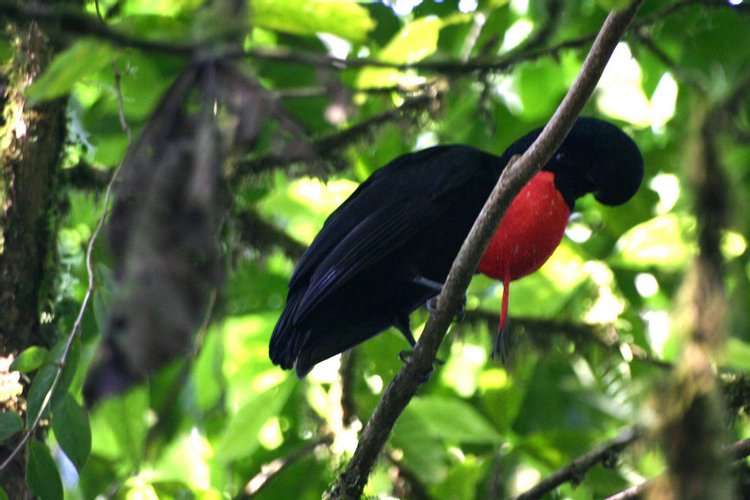
Bare-necked Umbrellabird
Bare-necked Umbrellabird (Cephalopterus glabricollis). Spanish name: Pajaro-sombrilla Cuellinudo, Pajaro Danta
Habitat
This bird is found in the middle to upper levels of primary forest in Caribbean lowlands.
Range
The Umbrellabird lives in Costa Rica and western Panama. While most of its year in spent in the foothills and adjacent lowlands of the Caribbean slope where females mostly live below 200 m and males from 100 to 500 m, the species migrates higher to breed between 800 and 2,000 m.
Physical Description
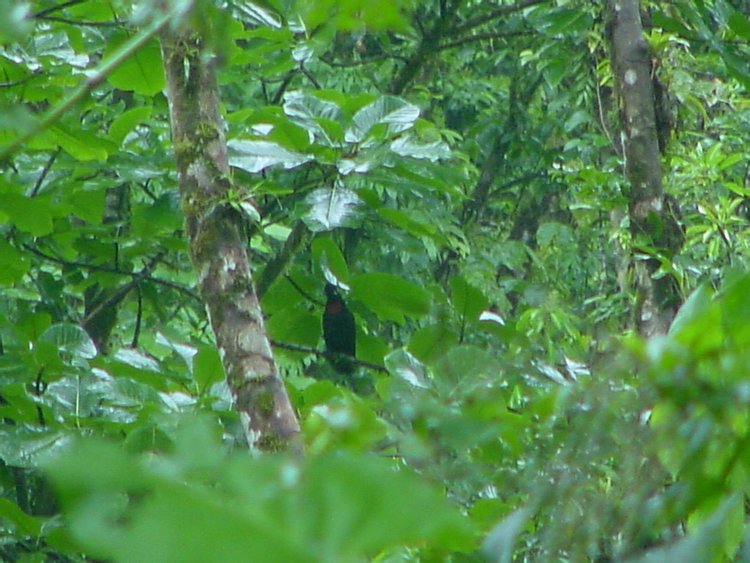
With one of the more unusual plumages found in Costa Rica, the uncommon Bare-necked Umbrellabird is an intriguing sight. Both sexes have a large stocky body, a hefty bill, a short tail and wide, long wings. The size of their heads is exaggerated by the umbrella crest that extends over their beaks. The male's crest is much larger than his counterpart's: the long black feathers cover the middle of his face and reach down to the end of his beak in a poofy manner. The female's crest is much shorter, almost resembling an odd crew-cut, making her head look flat. The male has bluish black back feathers which the female lacks; he also has a huge bright orange-red sac of skin on his throat that he can inflate during display in breeding rituals.
Interesting Biology
Outside of the breeding season, the Umbrellabird lives alone or migrates in a small flock. It forages in primary forest, from midlevel to the canopy, looking for fruiting trees. It may venture into tall second growth bordering the closed canopy zone as well. It is not a stealthy hunter, noisily coughing, grunting, or chuckling as it sallies from a perch to food or as it inspects the branch on which it sits for prey. The Umbrellabird smacks its prey against a branch before swallowing it.
During the breeding season, the Bare-necked Umbrellabird uses an exploded lek mating system, meaning the males form loosely bound groups to perch and display in a designated area. Leks of the Umbrellabird contain four males, who each pick three perches from 5 to 10 m high, where they spend all their daylight hours except when they need to feed. As they display, a male will inflate his throat sac until it looks like an enormous fruit emerging from the bird, and then he leans forward and releases a loud, booming HOOM that carries far and sounds like a bull or a hit to an oil drum, after which he leans back his head and finishes with raspier notes. The females approach these leks in the subcanopy when they hear this call.
Diet
In terms of fruit, the Bare-necked Umbrellabird mostly eats of palms such as Lauraceae and Annonaceae; for prey, this bird will catch large insects like katydids, grasshoppers, or cockroaches (and other Orthopterans), and caterpillars; they may also eat small lizards or frogs.
Height/Weight
Adult male Umbrellabirds weigh 450 g and reach 41 cm in length; smaller females weigh 320 g and reach 36 cm in length.
Brief Taxonomy
Order: Passeriformes
Family: Cotingidae
Sources
Johnsgard, Paul A. Arena Birds: Sexual Selection and Behavior. Smithsonian Institution Press, Washington, 1994.
Skutch, Alexander F. and F. Gary Stiles. A Guide to the Birds of Costa Rica. Utica: Cornell University Press,1989.
-Amy Strieter, Wildlife Writer
Glasswing Butterfly
Glasswing Butterfly (Greta oto). Spanish name: Espejitos
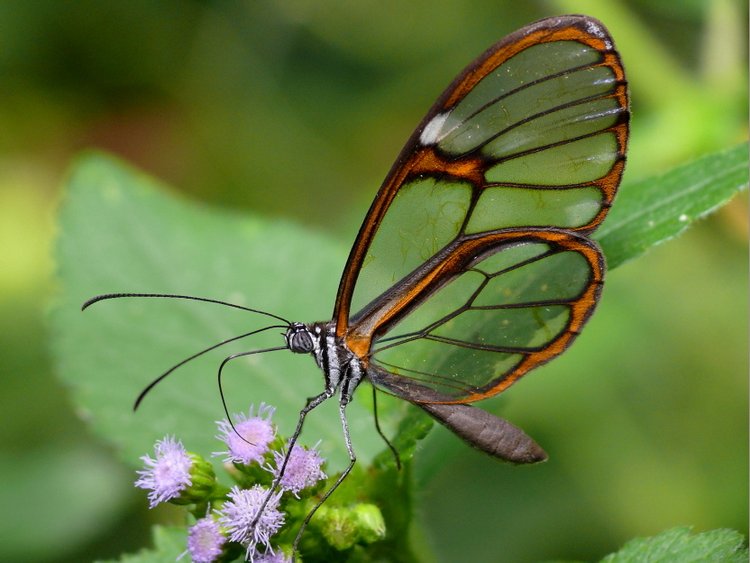
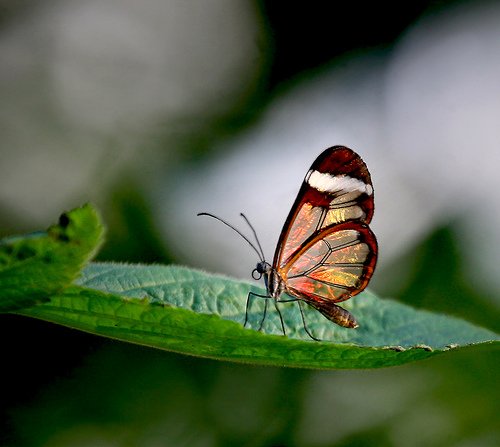
Habitat and Range A migratory butterfly, Greta oto is found in virtually all habitats in Central America. This glasswing ranges from Mexico to Panama.
Physical Description
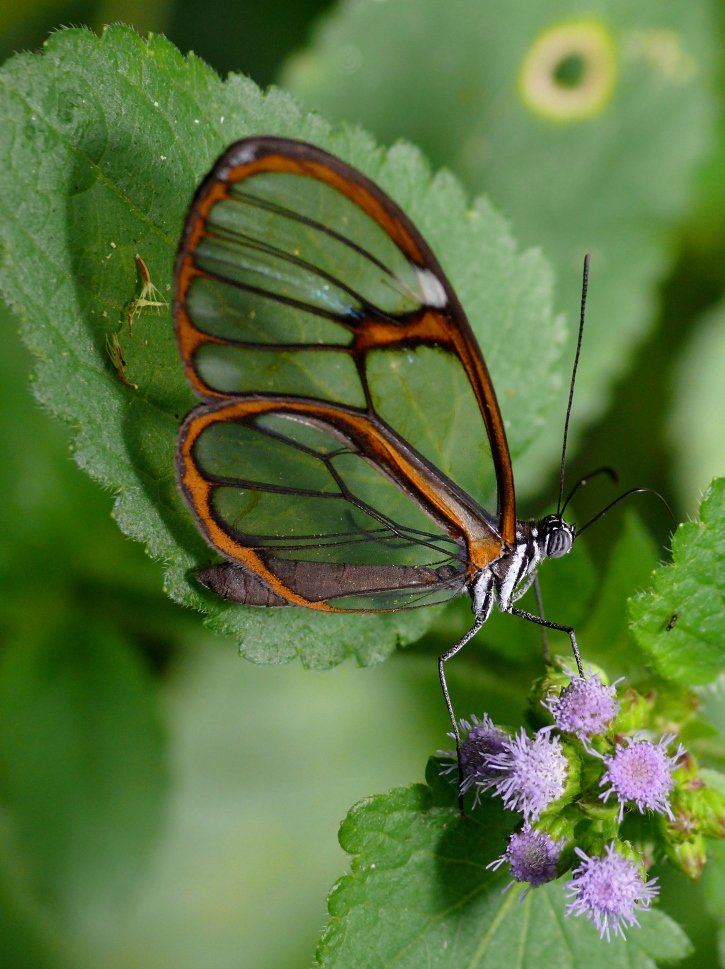
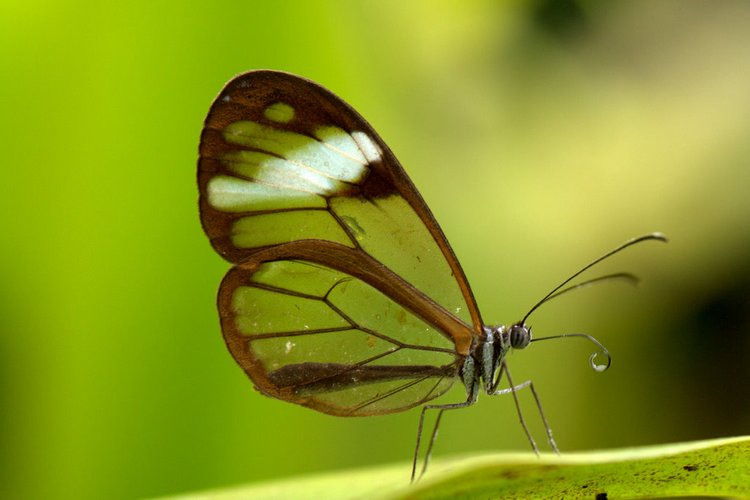
The glasswing is so named because of its gloriously transparent wings. A brown to reddish-brown border helps make Greta oto’s wings more visible. The upper part of the forewing also has a white stripe through the brown region. Glasswings lack the tiny scales on most of their wings that give other butterflies and moths their colors, so the wings are, literally, see-through. It is very hard for the eye to follow as the butterfly dodges between understory plants among patches of light and shadow.
These are hard to spot even when the caterpillars are undergoing metamorphosis: they transform into small pupae with a chrome-silver color that masks them as, perhaps, water glistening in droplets on stems. These pupae look like small mirrors, which is why they are called espejitos in Costa Rica.
Adults have scaly antennae and an elegantly thin, brown body powering the delicate, clear wings (the veins in their wings are visible). Males have an additional feature to their wings: on the hind wing is a small plume of fine hairs that stay tucked under the overlap of the forewing most of the time. These become helpful in courtship.
Biology and Natural History This species, Greta oto, is one of the most abundant ones and is spotted more often than some of its relatives in Central America. It can be found all year long, but month to month a population may fluctuate. An individual G. oto may travel as far as 12 km in a single day while it is migrating.
As an adult, this butterfly drinks the nectar of certain flowers (Asteraceae and Boraginaceae). The glasswing’s body absorbs chemicals from the nectar which make the glasswing taste unpleasant enough to discourage predators from eating it. The butterfly also uses the alkaloids to produce sex pheromones.
To find a mate, males congregate in shady corners of a forest and give off these pheromones to “call” females. The long hairs that males have tucked away help magnify how stinky they are, sort of the way hair makes an armpit smell stronger. Females smell the males and join the congregation to find a mate.
Diet
The host plants for Greta oto are two species of Cestrum. This glasswing (like others) also will feed on the droppings from birds that eat insects—by doing this, the glasswing gets amino acids into its diet.
Height/Weight
The average length of a glasswing butterfly is 28 to 30 mm.
Taxonomy
Order: Lepidoptera
Family: Nymphalidae
Sources
Chacón, Isidro and Montero, José. Butterflies and moths of Costa Rica. Instituto Nacional de Biodiversidad, Costa Rica, 2007.
DeVries, Philip J. The Butterflies of Costa Rica and Their Natural History: Papilionidae, Pieridae and Nymphalidae. Princeton, NJ: Princeton University Press, 1987.
-Amy Strieter, Wildlife Writer
Kinkajou
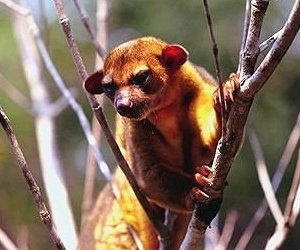
Kinkajou (Potos flavus). Spanish name: Martilla, Cuchicuchi
Habitat
The kinkajou lives in the canopy of several stages of forest, including mature, disturbed, and secondary rainforest; they may also be found in gallery forest, deciduous forest, and sometimes gardens and plantations.
Range
This mammal lives from Veracruz, Mexico to Mato Grosso, Brazil; it is rarely above 500 m, but may reach 1,750 m in elevation.
Physical Description
Reddish to smoky gray-brown, this monkey-like animal often has a dark brown stripe on its back. Its underside is yellow to pale orange. Their bodies are covered in dense, soft, short fur. The round head and face are red-brown to black with a short pointed muzzle. Kinkajous have large, round, brown eyes set far apart; in the moonlight (or the beam of a flashlight), their eyeshine is yellow-white to greenish white. They have a long, extensible tongue that is dark at the tip.
The kinkajou has long curved claws that help it live arboreally high up in the canopy. It is extremely agile and muscular, but surprisingly short-legged for their movements. It has a long back and a distinct prehensile, tapered tail that it usually keeps curled around a branch while moving or feeding. This animal is noisy as it runs and jumps from tree to tree at night.
Olingos look similar to kinkajous, but they can be told apart because the olingo is smaller, has a nonprehensile tail with a bushy tip, and at night the olingo's belly looks dark, whereas the kinkajou's looks pale.
Biology and Natural History
Widespread and common, the kinkajou persists although it is hunted for meat and the pet trade.
Kinkajous often live solitarily, or in pairs, but several kinkajous may feed in a tree at one time at night; during the day they sleep in tree hollows. Several males may have large ranges that overlap a female's smaller range. She will have one baby at a time, and they will keep their bond for a while. Kinkajous are highly vocal, using sneezing whistles and other sounds.
Diet
This mammal mostly eats fruits, especially figs, as well as insects, especially ants; it may also eat arboreal vertebrates. In the dry season it drinks flower nectar. This species is an important disperser of Ficus spp., Virola spp., and Inga spp.
Height/Weight
The head and body length is 0.5 m; tail length 0.45 m; they weight about 3 kg.
Taxonomy
Order: Carnivora
Family: Procyonidae
Sources
Eisenberg, John. Mammals of the Neotropics, Vol. 1. The University of Chicago Press: Chicago, 1989.
Emmons, Louise H. Neotropical Rainforest Mammals: A Field Guide, 2nd Ed. University of Chicago Press: Chicago, 1990.
Wilson, D. E. in Janzen, Daniel H. Costa Rican Natural History. Chicago: University of Chicago Press, 1983.
-Amy Strieter, Wildlife Writer
Long-tailed Manakin
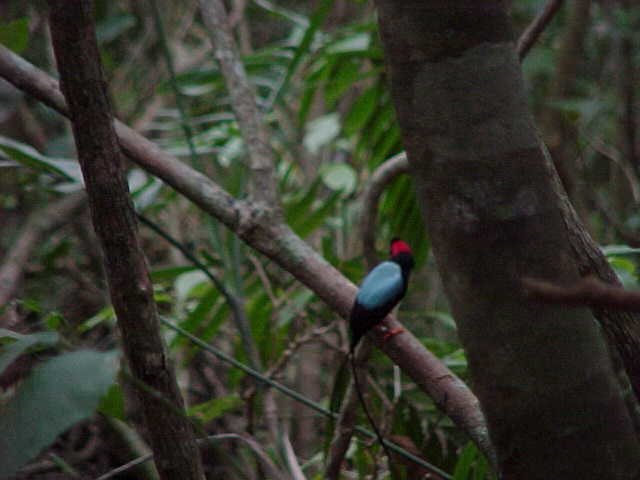
Long-tailed Manakin (Chiroxiphia linearis). Spanish name: Saltarín Toledo
Habitat
This manakin lives in tropical dry and moist and subtropical moist forest; it is often in thickets, vine tangles, and middle-level trees.
Range
The Long-tailed Manakin is found on the Pacific side of Central America from southern Mexico (Oaxaca and Chiapas) to central Costa Rica.
Physical Description
The Long-tailed Manakin is covered in rich plumage. The male is brighter, with a crimson red crown, pale blue back and shoulders, and two very elongated tail feathers that double the length of the body; the rest of the body is black, with bright orange legs and feet. The female is dull in comparison: she is a solid olive green with a paler green underside, orange legs and feet, and tail feathers that are only slightly elongated. It takes young manakins 3 to 4 years to assume their full plumage.
Interesting Biology
The only manakin present in most of its range, the Long-tailed Manakin exhibits a breeding mechanism called lek-breeding. Two or three males together perform courtship displays in one of several 'courts' in an 'arena'— these are designated areas in their habitat.
The males sing together to attract females; when one appears, she and the males engage in lengthy and complicated displays until the dominant male copulates with her. Then she leaves to raise the young herself. The males, however, stay in their displaying partnership for one to several years; they are not related, but seem to actually be attached to each other. The dominant male assumes all copulations. The other male stays in the partnership because he will take the dominant position in their court after his partner leaves.
Meanwhile, the female constructs a shallow cup of moss, leaves, and cobwebs between twigs in a small tree, and lays 1-2 beige-tan eggs spotted with dark brown.
Diet
This manakin uses a sallying technique to forage: it keeps a central perch, leaving it repeatedly to seize fruits off of trees, then returning to the perch. This bird's diet is almost exclusively comprised of fruit, especially those of Cecropia peltata, Cocoloba caracasana, and Trema micrantha.
Height/Weight
These birds weigh about 19 g. The body of the Long-tailed Manakin is 11.5 cm; adult males have an additional 10-15 cm of tail feathers, and adult females have tail feathers 2-3 cm long.
Brief Taxonomy
Order: Passeriformes
Family: Pipridae
Sources
M. S. Foster in: Janzen, Daniel H. Costa Rican Natural History. Chicago: University of Chicago Press, 1983.
Skutch, Alexander F. and F. Gary Stiles. A Guide to the Birds of Costa Rica. Utica: Cornell University Press, 1989.
Amy Strieter, Wildlife Writer
Olingo
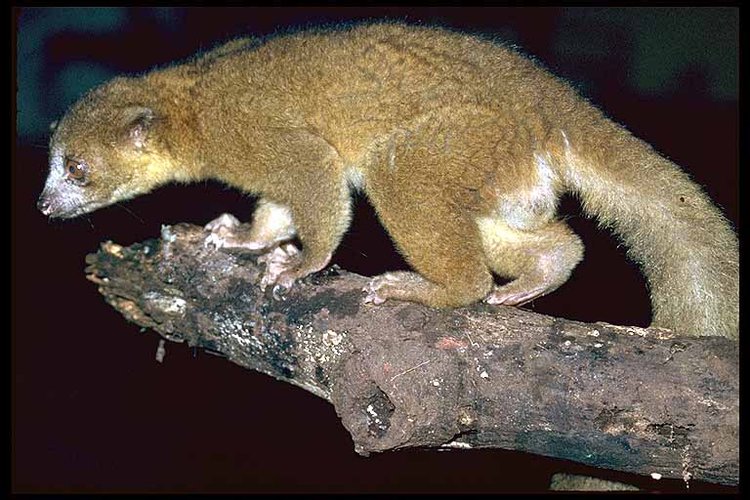
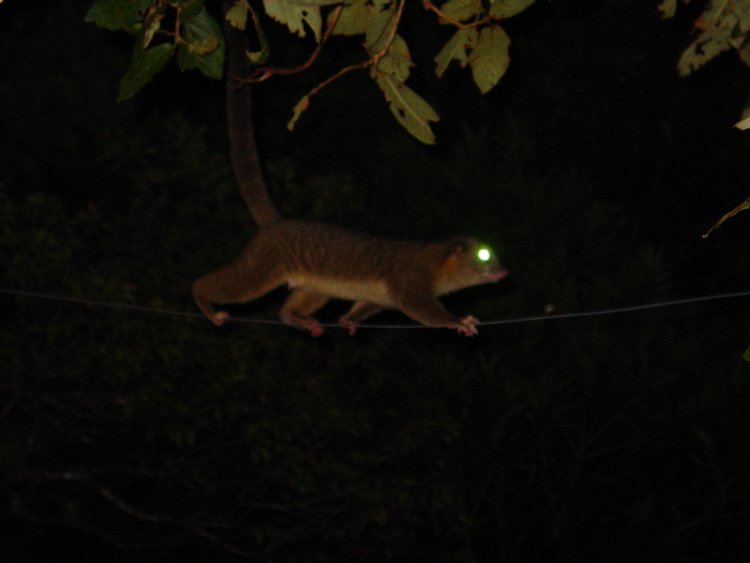
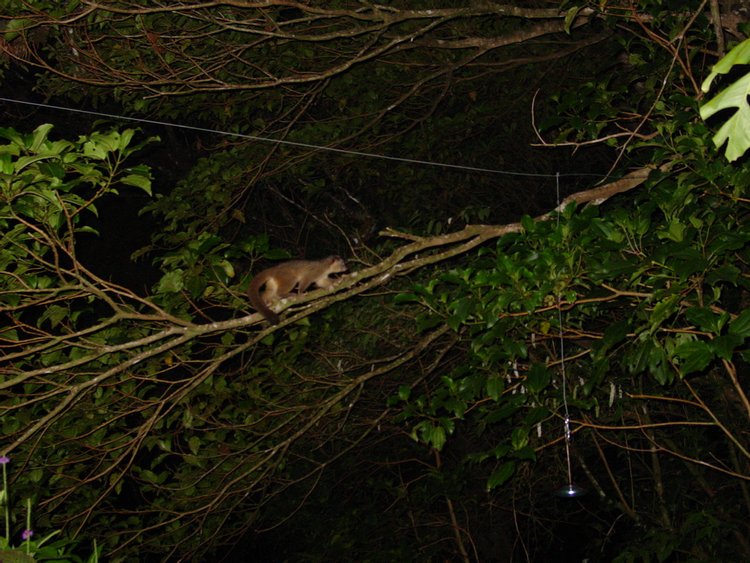
Olingo (Bassaricyon gabbii). Spanish name: Olingo
Habitat
Olingos live in tropical evergreen forests below 2,000 m in elevation.
Range
The Olingo lives from southern Nicaragua to Ecuador and east of the Andes from Venezuela and Guyana to Bolivia in the western half of the Amazon basin.
Physical Description
This solitary mammal has drab brown, long, soft, dense fur, with darker fur on top of its head. Its underside is paler. The olingo is equipped with large, round brown eyes with a bright eyeshine, small ears, and an extremely long tail that is longer than its head and body. The tail helps distinguish this night creature from the kinkajou because the olingo's tail is banded and nonprehensile; the olingo also carries its tail straight out behind it when traveling, whereas the kinkajou keeps its tail curled around branches as it moves. A kinkajous also are twice the weight of an olingo, their fur is shorter and more reddish, and of course, they have a prehensile tail.
Biology and Natural History
There are six olingo species in Central and South America, all with minor differences from the others. The olingo is a nocturnal, arboreal omnivore related to the raccoon.
Agile and active, the olingo stays high in the canopy, lightly passing through the branches, feeding quickly, and moving on. It is a noisy traveler but not so much as the kinkajou. Olingos use an alarm call if necessary, and less often a sneezing vocalization. They may feed in the same trees as kinkajous and night monkeys, but adults usually forage alone, and they are less social than kinkajous. During the day, olingos shelter in hollow trees. A female will have a single baby after a 73-74 day gestation period, and the infant is small and gray-brown with faint dark stripes.
The olingo is not as adaptive as the kinkajou to disturbed forest or human-use areas. Perhaps it is for this reason that the olingo is not as common as the kinkajou, although they are still widespread. The olingo is less hunted than the kinkajou, but they are still very threatened by deforestation.
Diet
Similar to kinkajous, olingos eat fruit (especially figs), invertebrates, and small vertebrates; in the dry season they also drink nectar from some flowers such as balsa. The olingo is more carnivorous than the kinkajou.
Height/Weight
The olingo head and body length is generally 0.36 to 0.41 m, with a tail as long or longer, of 0.37 to 0.52 m. Adults weigh 1.1-1.4 kg.
Brief Taxonomy
Order: Carnivora
Family: Procyonidae
Sources
Eisenberg, John. Mammals of the Neotropics, Vol. 1. The University of Chicago Press: Chicago, 1989.
Emmons, Louise H. Neotropical Rainforest Mammals: A Field Guide, 2nd Ed. University of Chicago Press: Chicago, 1990.
Wilson, D. E. in Janzen, Daniel H. Costa Rican Natural History. Chicago: University of Chicago Press, 1983.
-Amy Strieter, Wildlife Writer
Owl Butterfly
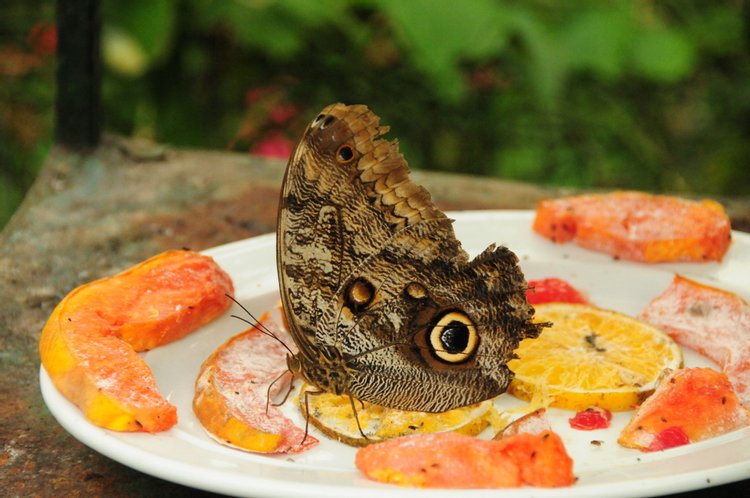
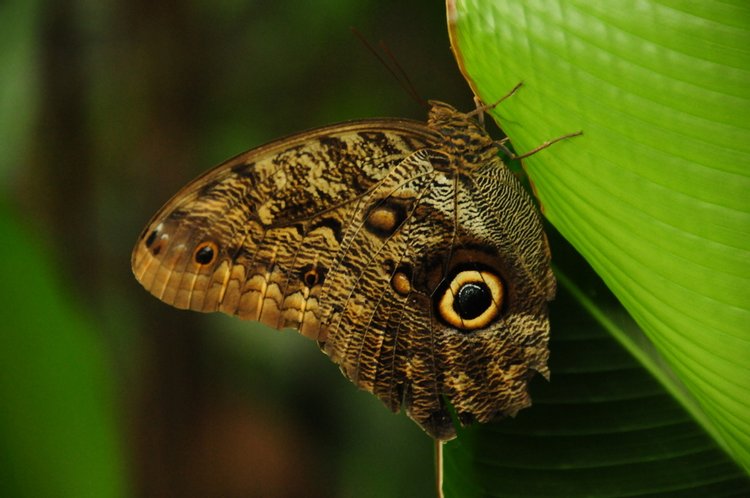
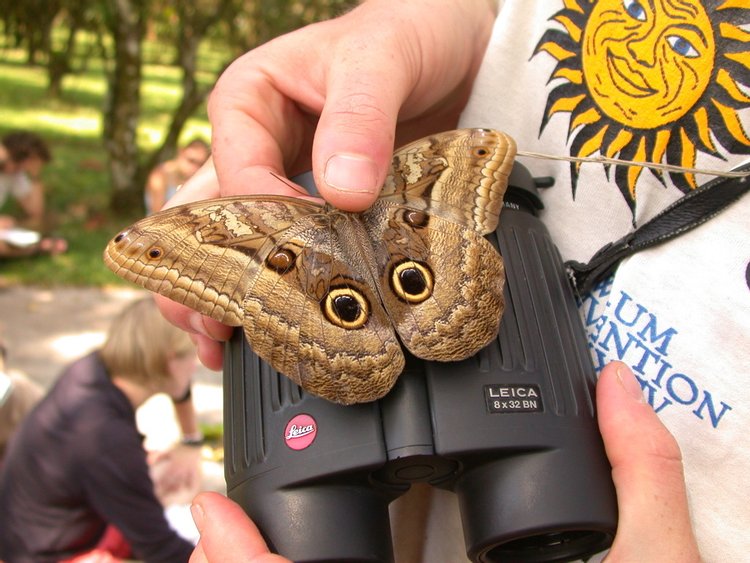
Owl Butterfly (Caligo memnon). Spanish name: Buho
Habitat
This butterfly frequently rests near banana crops or other agricultural areas. It is common in lowland forests, but cannot survive in areas with lots of rainfall.
Range
Speaking generally, the caligo can be found from southern Mexico down through Central America and Colombia and into Peru and the Amazon. It can live as high as 1,500 m in elevation.
Physical Description
Two helpful characteristics to identify this butterfly are its large size and eye spots. One of the largest butterflies in Central America, the caligo often sits with its wings closed, showing only the brown and gray undersides decorated with large, yellow-ringed eye spots. The Caligo memnon has a particular region of yellowish cream scales on the upper wings. This blends into dark bluish colors on the outer edges.
The caterpillar stage of this species is also distinct because of its enormous size. It is a soft striated brown with black spines projecting out of its back. These look painful, but deceptively so. The reddish head has thick “horns,” and the tail is wide and forked. The chrysalis can be pale green to dull brown, and from below resembles the head of a viper.
Biology and Natural History
The caterpillars start small, but become gigantic, and can be conspicuous on the leaves of banana plants or other host plants. This owl butterfly is more visible around dawn and dusk, but may also be active during the day. It remains in shadier patches of forest and hides well, but is hard to miss when it takes flight. When flying the owl butterfly rises and falls as the large wings alternately show dark brown and purplish blue.
The brown pattern on the underside of its wings does help it blend in with the surrounding forest, but the large, brown, eye-shaped circles on each wing may also resemble the eye of a larger animal. The purpose may be to draw a predator to aim for “eye” on the lower edge of the wing (which it mistakes for a head), which may give the butterfly a greater chance of escaping with its life and only lose part of a wing. When the caligo is startled from its resting place on a tree trunk, it flashes open its wings as it tries to escape, exposing the dusky blues and purples that were hidden when closed.
Diet
Butterflies in this family are drawn to feed on the juices of fermenting fruits. Banana, pineapple, and mango are very attractive to this butterfly as an adult. When it is a caterpillar, banana and heliconia are the main host plants.
Height/Weight
One of the largest caterpillars in Costa Rica, Caligo memnon bodies can reach 15 cm in length. As adults, the butterfly wingspan is usually 12 to 15 cm.
Taxonomy
Order: Lepidoptera
Family: Nymphalidae
Sources
DeVries, Philip J. The Butterflies of Costa Rica and Their Natural History: Papilionidae, Pieridae and Nymphalidae. Princeton, NJ: Princeton University Press, 1987.
DeVries, P. J. in Janzen, Daniel H. Costa Rican Natural History. Chicago: University of Chicago Press, 1983.
Goode, Mark R. An Introduction to Costa Rican Butterflies. San José, Costa Rica. 1999. ISBN 9977-12-365-9.
Kricher, John. A Neotropical Companion: an introduction to the animals, plants, and ecosystemsof the New World tropics. Princeton University Press: Princeton, NJ, 1997.
Hogue, Charles L. Latin American Insects and Entomology. University of California Press: Berkely and Los Angeles, 1993.
-Amy Strieter, Wildlife Writer
Rhinoceros Beetle
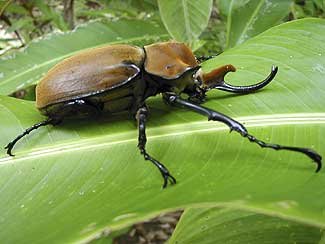
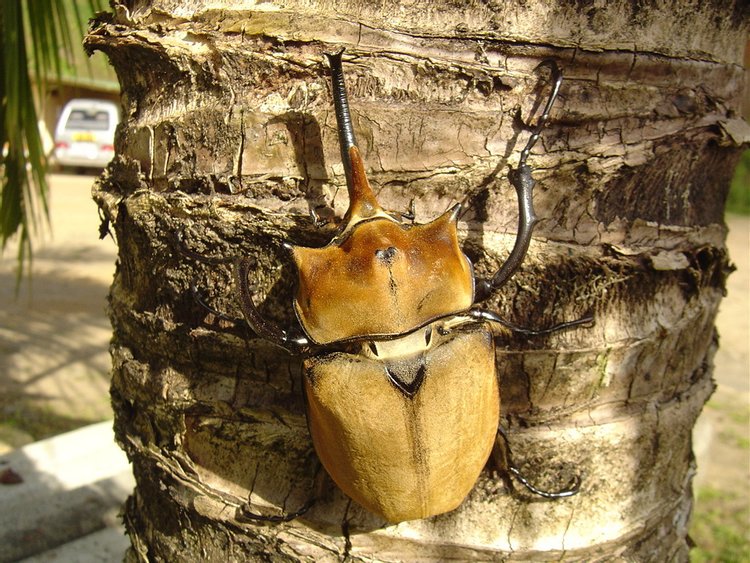
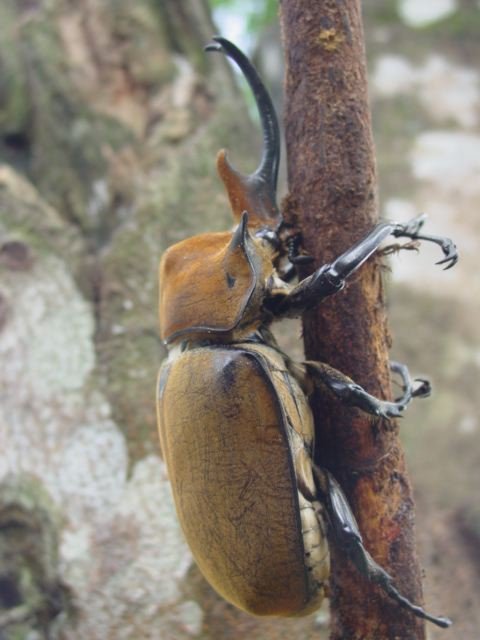
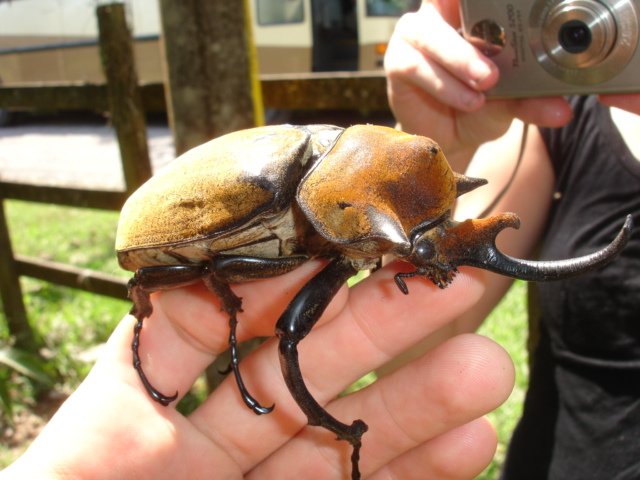
Rhinoceros Beetle (Megasoma elephas). Spanish name: Cornizuelo
Habitat
Lowland rainforest is suitable for this beetle, but mature forest is required for the beetle to survive. In younger stages, it lives inside large fallen trees.
Range
The rhinoceros beetle can be found from southern Mexico down to northern Colombia and northern Venezuela.
Physical Description
The rhino is one of the strongest insects in the world with relation to its body size, and is the largest beetle within countries like Costa Rica. The male is unmistakable with his massive size and long, intimidating horn that curves up. He has additional, shorter horns that project out from his head, but the long one is used for fighting. Females are smaller and do not have such a dramatically adorned head. The light to dark brown rhinoceros beetle can look almost velvety because it has fine, short hairs over the exoskeleton. This rhinoceros can fly short distances, although its heavy body makes it rather ungraceful in flight.
The hercules beetle (Dynastes hercules) takes second in size compared to the rhinoceros, and the hercules has a second long horn curving down towards the lower one. It is not as hairy.
Biology and Natural History
Males look built to fight, and they are. Two males will approach each other to compete, often in a tree. They grapple with their horns, and the winner is whoever first lifts his opponent off his feet and knocks him over. Males fight over females and feeding sites, but they are not very aggressive otherwise.
These large, impressive beetles come from humble means. The entire lifespan of the rhinoceros beetle is 3 to 4 years, but approximately 2 of those years are spent as a grub. In the grub, or larval stage, the beetle munches on decaying wood on the inside of a fallen tree. Since trees in the Tropics decay very quickly and the grubs develop slowly, the grubs will become exposed or run out of food unless they are in a large fallen tree. This is why Megasoma elephas populations can only live in forest mature enough to have a sufficient number of large, fallen trees. Unfortunately, because many parts of tropical lowlands have been deforested, or at least overcut, the rhinoceros beetle is rare and struggling to survive.
Diet
In its younger stages this insect digests decaying wood. As an adult it feeds on fruit and sap.
Height/Weight
Adults weigh between 18 and 28 g. Males are between 55 and 80 mm long. Females are lighter but can be slightly longer.
Taxonomy
Order: Coleoptera
Family: Scarabaeidae
Sources
Howden, H. F. in Janzen, Daniel H. Costa Rican Natural History. Chicago: University of Chicago Press, 1983.
Kricher, John. A Neotropical Companion: an introduction to the animals, plants, and ecosystems of the New World tropics. Princeton University Press: Princeton, NJ, 1997.
Amy Strieter, Wildlife Writer
Spiny Green Lizard
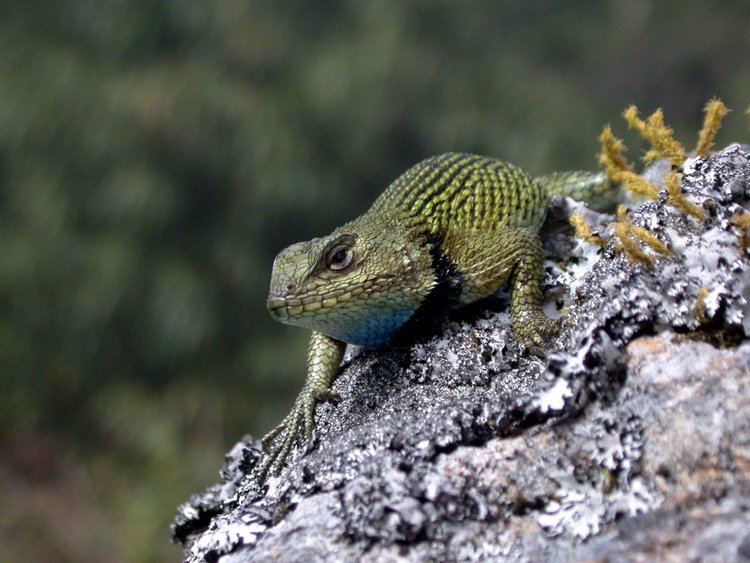
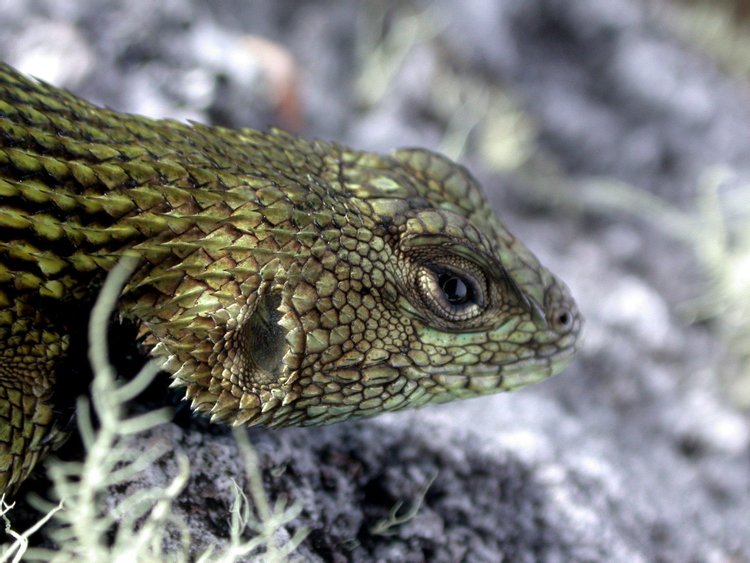
Spiny Green Lizard (Sceloporus malachiticus)
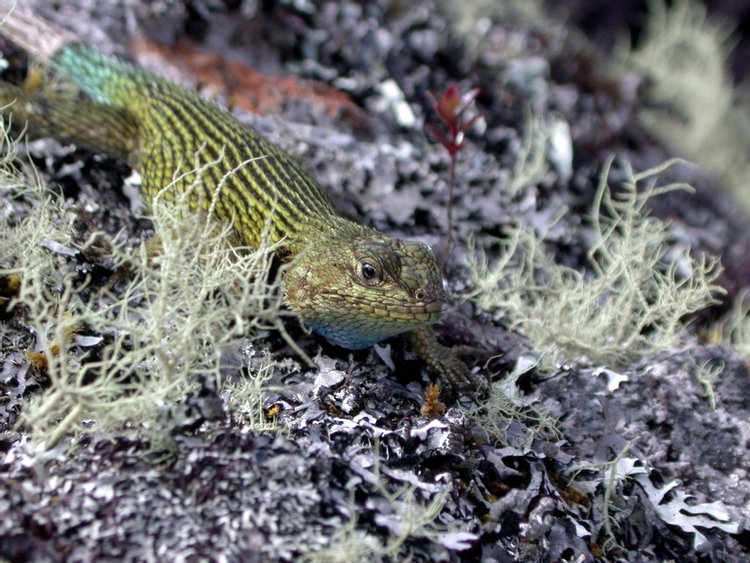
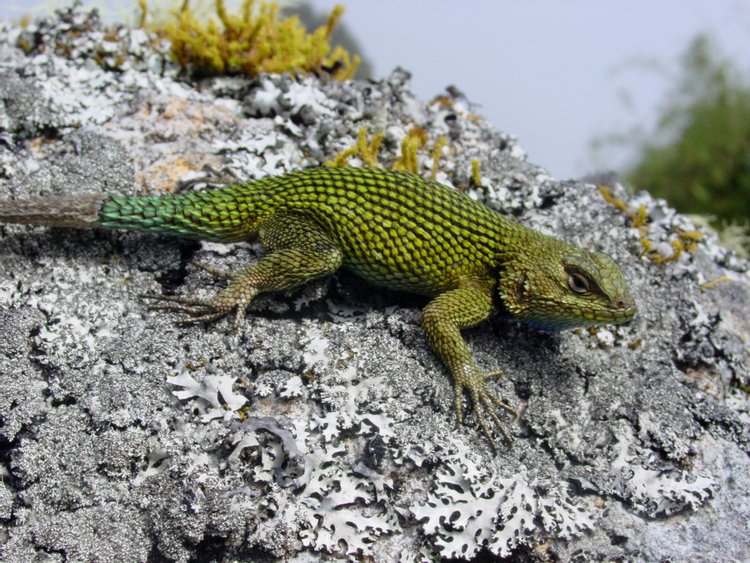
Habitat
Commonly found in open patches of sunlight on trees, rocky outcroppings, pastures, fences, logs, tile roofs, or gardens. Premontane, montane, and even subalpine regions are home to this lizard. Human-dominated and even urban areas are not foreign territory to the species.
Range
From Guatemala’s mountains, through Costa Rica, and down to western Panama, the Spiny Green Lizard lives from 600-3,800 m in elevation.
Physical Description
The Green Spiny Lizard somewhat describes itself. The small reptile’s stocky body is armored in small spiny scales, but the blunt-nosed head has smooth scales. The lizard is a mostly solid metallic color, but this varies per individual and changes throughout the day, helping adjust body temperature. An individual may tend to be a bright green, bluish green, yellowish green, or as dark as slate or black. Most can become this darker color as they try to absorb more sunlight. Males may have a black stripe around the neck and a bright blue tail; females may also have blue markings. At lower elevations, the Spiny Green Lizards tend toward the brighter greens; at higher elevations, the same species is more dully colored. In both situations they tend to be darker in the morning and become brighter as the sun climbs towards its peak.
Biology and Natural History
Much of this heliothermic lizard’s day is structured around adjusting and maintaining body temperature. To raise body temperature, this animal basks in the sun, so it is commonly visible where it lives. At lower elevations it is found more on trees, roofs, fences, and high perches. At higher elevations it is more terrestrial, clinging to dry, warm spots on rocks or logs. The Spiny Lizard flattens and spreads out its body to absorb more sunlight; when it is warm enough, it will hunt or retreat to shadier spots. This is related to the color variation with elevation—lizards at cool, higher elevations can speed up their heat absorption with darker body colors.
This reptile is little but territorial and males will keep their home ranges far apart, although they may overlap with multiple female ranges. While perching to bask or protect its territory, S. malachiticus will also scan for small prey and run after it. When threatened by a predator, such as a bird, snake, or small mammal, this species will quickly abandon its perch and rapidly retreat to safety.
The female will incubate her eggs within her body and give birth to live young in litters of about six. This lizard often can survive in cold climates, but eggs are sensitive to temperature change. The female protects them from this vulnerability.
Diet
The food for this lizard mostly consists of arthropods, particularly insects.
Height/Weight
Males are generally within the range of 67-98 mm in snout-vent length; females are slightly shorter, at 64-94 mm. The tail will approximately double the total length of the lizard—including it, the animal is about 200 mm long.
Taxonomy
Order: Squamata
Family: Iguanidae
Sources
Leenders, Twan. A Guide to Amphibians and Reptiles of Costa Rica. Zona Tropical, S.A, Miami, FL, 2001.
Robinson, D. C. in: Janzen, Daniel H. Costa Rican Natural History. Chicago: University of Chicago Press, 1983.
Savage, Jay M. The Amphibians and Reptiles of Costa Rica: A Herpetofauna between two Continents, between Two Seas. The University of Chicago Press, Chicago, 2002.
Savage, J. M., N. J. Scott, and D. C. Robinson in: Janzen, Daniel H. Costa Rican Natural History. Chicago: University of Chicago Press, 1983.
-Amy Strieter, Wildlife Writer
Tayra
Tayra (Eira barbara). Spanish name: Tayra
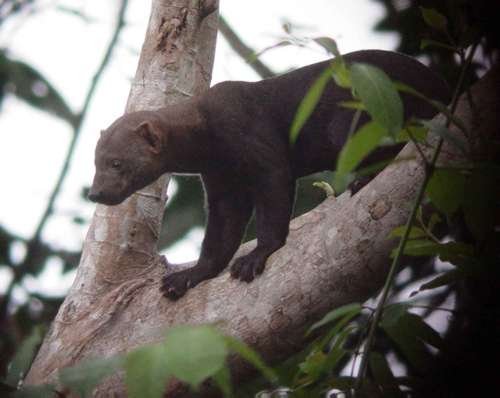
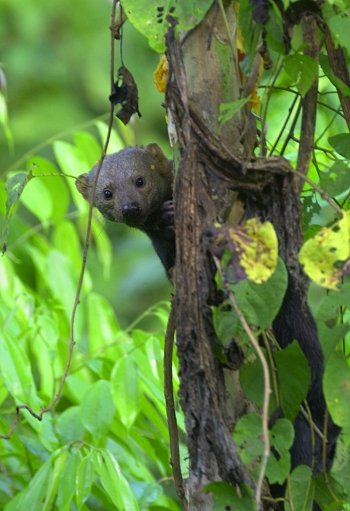
Habitat
The tayra prefers tropical evergreen forests but may also live in dry deciduous forests; they exist below elevations of 1,200 m.
Range
Tayras are found between central Mexico to tropical southern South America.
Biology and Natural History
This chocolate brown to black mustelid is related to the mink and otter. It is a long, slender, able climber with strong claws, resembling a thin-haired, lanky, very large mink with a long tail covered in hair longer than the hair on the rest of the body.
Tayras are mostly diurnal, but may be active at night as well. They forage on the ground or in trees, but do not forage in water like otters. They are curious foragers, and eat a wide variety of foods. They function solitarily or in family groups, and are very vocal when they interact with each other. Their litters can have up to 2l active, playful young.
Diet
Tayras look for fruit, small vertebrates, and invertebrates, as well as eggs, lizards and carrion. They are also known to eat agouti and rabbit, suggesting their diet is similar to raccoons, coyotes, and small cats.
Height/Weight
Head and body length is 60 to 68 cm, with a tail 38 to 47 cm; they can weigh more than 5 kg.
Taxonomy
Order: Carnivora
Family: Mustelidae
Sources
Janzen, Daniel H. Costa Rican Natural History. Chicago: University of Chicago Press, 1983.
Wilson, D. E. in Janzen, Daniel H. Costa Rican Natural History. Chicago: University of Chicago Press, 1983.
-Amy Strieter, Wildlife Writer
Photos:
- Biosphere Expeditions Organization website.
Three-wattled Bellbird
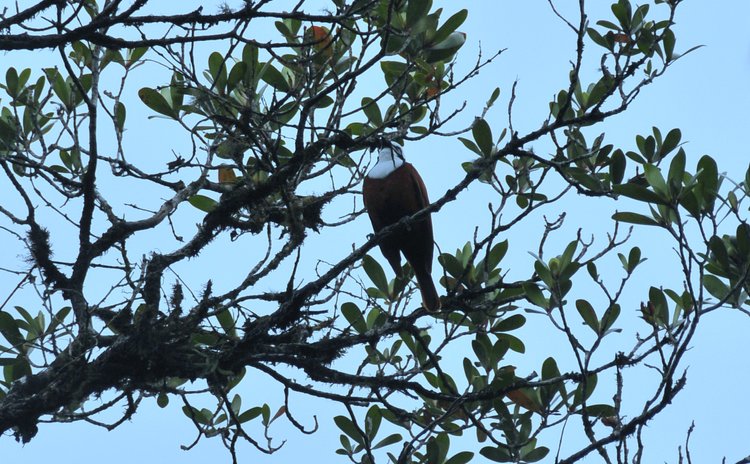
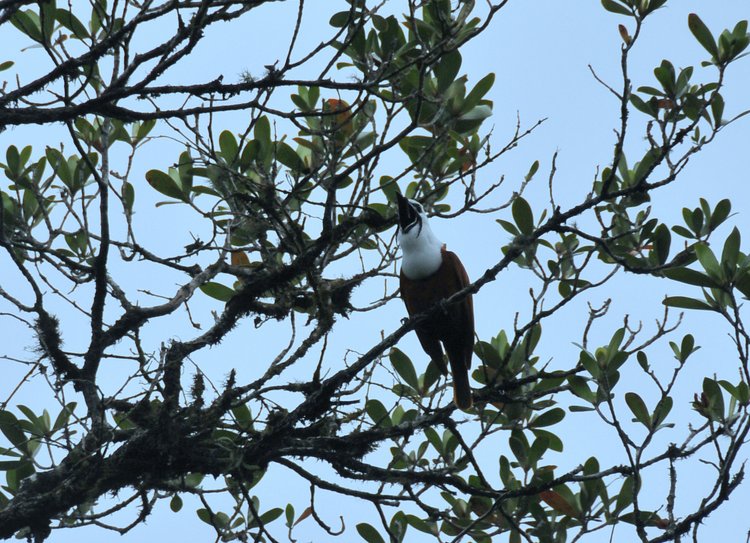
Three-wattled Bellbird (Procnias tricarunculata). Spanish name: Campanero Tricarunculado, Pajaro Campano, Rin-ran
Habitat
Usually the bellbird is found in middle to upper forest levels within lowland to montane regions between 900-3,000 m or higher. It is usually found in lower elevations outside the breeding season.
Range
The Three-wattled Bellbird lives between eastern Honduras and western Panama.
Physical Description
An abrasive BONK is often heard in the muted sounds of the forests where this Bellbird perches. The male's well-projected call can be heard up to half a kilometer away, especially because the bellbird often sings in the highest branches of the canopy. The Three-Wattled Bellbird is named for the male's three skinny, extended gray-black wattles-worm-looking skin structures-which hang from his bill.
The female lack these wattles, and in fact looks entirely different from the male. Adults of both sexes have a sturdy, heavy body and a large black bill. The female is olive green with thin yellow lines on her head, a skinny yellow eye-ring, and a bright yellow underside with wide dark olive-green stripes. The female is thusly well hidden among the lush green of the canopy. The male, on the other hand, is shrouded with a bright white on its head, neck and chest, and a solid chestnut-rufous color over the rest of its body.
Interesting Biology
In the breeding season these birds stay in the middle to upper zones of montane forests. During the rest of the year they may spend time at lower levels or in secondary growth and tall trees in semi-open areas. They forage for tree fruits by sallying, or repeatedly returning to a certain perch between trips to food targets.
Males display and BONK from perches that expose them above the rest of the canopy. They establish territories around these branches and spend much of their time there, especially during the breeding season from March to June when they leave only briefly to feed. They do not sing melodies as much as tones that may be wooden, metallic, or bell-like, from a BONK or BRENK to a jreet or other single notes. While they project these loud sounds, the males stretch open their huge, gaping black mouths and make their wattles quiver. The large mouth allows the bird to swallow larger fruits as well as signal threat when a visitor enters his territory. The male will approach the intruder and bonk! near its head and intimidate with his monstrously large black mouth and wobbling wattles. When the visitor is a female bellbird, however, the male performs display flights from perch to perch, and comes close to the female to bonk! in her ear; this excites the female, and the two may proceed with courtship rituals. She will depart from him afterwards to build a nest and raise the chicks alone.
Diet
The Three-Wattled Bellbird swallows the fruits of trees, particularly those in the Lauraceae family, of which the avocado is a member.
Height/Weight
Adult male bellbirds are 30 cm long and weigh 220 g; the smaller females are 25 cm long and weigh 145 g.
Brief Taxonomy
Order: Passeriformes
Family: Cotingidae
Sources
Johnsgard, Paul A. Arena Birds: Sexual Selection and Behavior. Smithsonian Institution Press, Washington, 1994.
Skutch, Alexander F. and F. Gary Stiles. A Guide to the Birds of Costa Rica. Utica: Cornell University Press,1989.
Stiles, F. G. in: Janzen, Daniel H. Costa Rican Natural History. Chicago: University of Chicago Press, 1983.
-Amy Strieter, Wildlife Writer
Violet Sabrewing
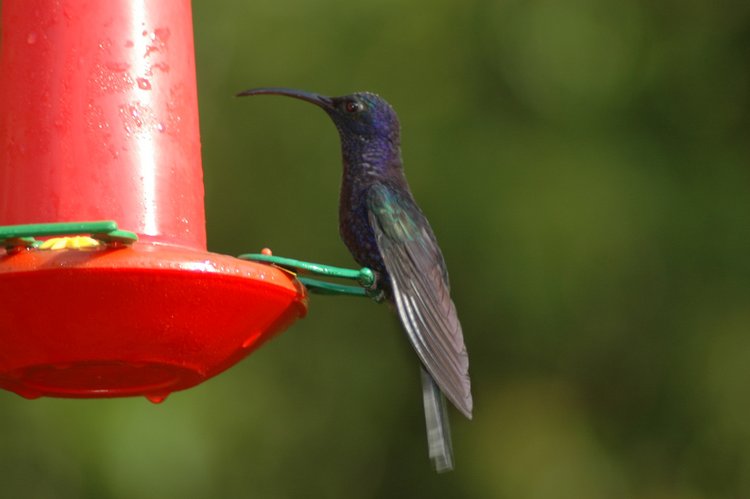
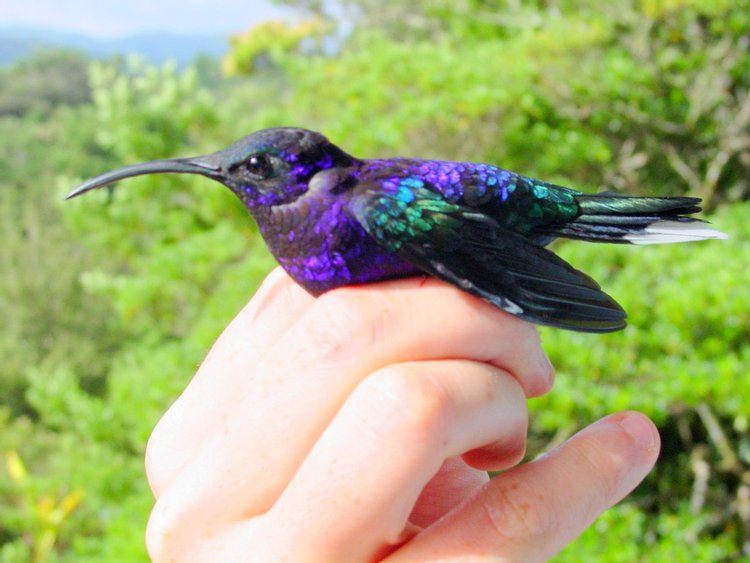
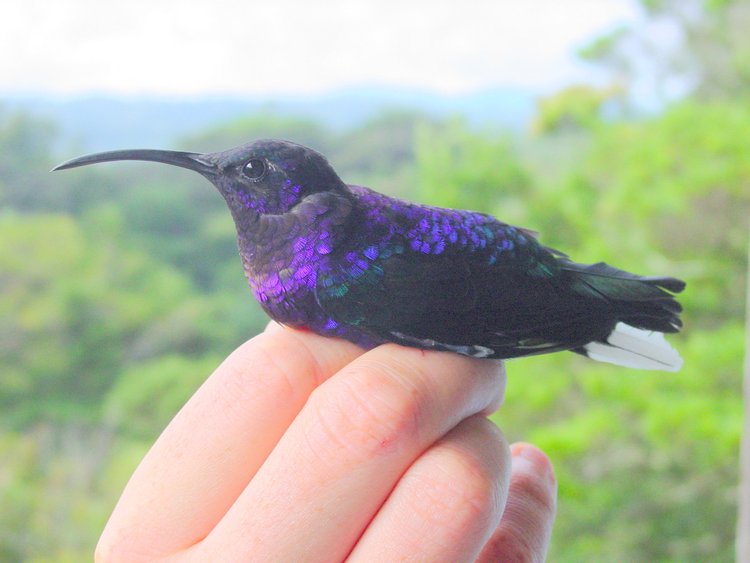
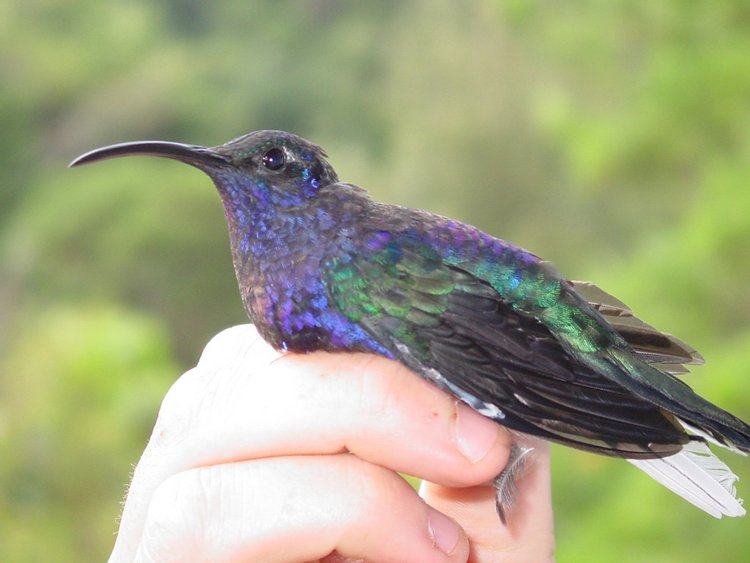
Violet Sabrewing (Campylopterus hemileucurus). Spanish name: Colibrí Morado
Habitat
This hummingbird is frequently found in montane forest understory and edge, ravines, areas around streams, as well as disturbed wooded areas and old second growth. It also often forages in banana plantations.
Range
From southern Mexico to western Panama, the Violet Sabrewing can be found at higher elevations, between 1,500 to 2,200 m, but it may descend to lower elevations after the breeding season.
Physical Description
The Violet Sabrewing is one of the largest hummingbirds in the world, matched in size only by a few other species, and surpassed only by the Giant Hummingbird.Although the male and female have divergent plumage, they share the wide, long tail with bright white corner feathers, wide wing feathers, conspicuous size, and the long, curved bill reminiscent of a hermit, such as the Long-tailed Hermit. The female's bill is especially curved; she is dark green with a gray underside and a violet throat. The male's plumage grants the species its name: his head and most of his body is a deep, solid violet, with dark green on some wing feathers and the lower back, a blackish tail, and the aforementioned white tail corners.
Interesting Biology
One reason this species is so easy to spot in the forest is that it flies relatively low and loudly, traplining many of the same flower species as hermits, since they have similar beak shapes. The Violet Sabrewing most prefers heliconia and banana flowers. It may also habitually visit certain flowers that open during the night for bats, such as those of Vriesia nephrolepis. The Sabrewing may come at dusk to rob the nectar of buds that have not yet opened, or at dawn to drink any residual nectar left by the bats.
One might think that such a large hummingbird would use size to its advantage and act highly territorially towards other hummingbirds. However, compared to smaller hummingbirds, the Sabrewing is not very aggressive, and is rarely protective or defensive at flowers. It still dominates at hummingbird feeders, and often other species vacate when they see the Sabrewing coming, before there is any bill sword-fighting. While solitarily feeding, both sexes use sharp vocalizations that may not be as loud as a larger bird's song, but are clearly audible twitter or "chip' sounds. Sabrewings can also be heard approaching because their vibrating wings are comparatively large for a hummingbird but still move incredibly fast.
Males may sing individually sometimes, but more often sing during the breeding season, when groups of up to 10 males (more often 4 to 6) join in a single area to sing and attract females. Such a formation is called a lek; males of this species gather in leks 2 to 4 m off the ground and sing from perches in the understory or edge habitats. After a female approaches the lek, chooses a male and copulates, she leaves to build a tiny nest. She will construct an awkward-looking but sturdy cup out of green moss, line it with other soft plant fibers, and bind the work with spider webbing. She usually does this on a low, skinny tree or bamboo branch over the edge of a ravine or water.
Diet
Like other hummingbirds, the Violet Sabrewing survives almost entirely on nectar. This species most favors heliconia and banana flowers, but also visits ginger plants (Costus), the bromeliad Vriesia nephrolepis, Gesneriads (such as Columnea, Drymonia), and several Acanthaceae flowers.
Height/Weight
This large hummingbird is generally 15 cm long. Adult males weigh 11.5 g, and females 9.5 g.
Brief Taxonomy
Order: Apodiformes
Family: Trochilidae
Sources
Fogden, Michael and Fodgen, Patricia. Hummingbirds of Costa Rica. Zona Tropical, S. A., Miami, 2005.
Skutch, Alexander F. and F. Gary Stiles. A Guide to the Birds of Costa Rica. Utica: Cornell University Press, 1989.
Amy Strieter, Wildlife Writer
Tours & Activities
Experiences in Monteverde Cloud Forest Reserve
Explore hand-picked Monteverde Cloud Forest Reserve tours and experiences led by local insiders, from wildlife encounters to cultural deep-dives.

Trips to Inspire
Monteverde Cloud Forest Reserve itineraries
Explore hand-picked Monteverde Cloud Forest Reserve itineraries designed by local insiders who know every hidden corner. Each trip is completely flexible, customized to your pace, travel style, and budget.
Inquire
36 days · Puerto Viejo de Limon, Tortuguero, Arenal, Monteverde +4
Couple
From misty cloud forests to sun‑kissed Pacific beaches, this Costa Rican adventure weaves together vibrant wildlife, volcanic landscapes, and endless ocean horizons. You’ll trek Monteverde’s canopy bridges, soak in Arenal’s hot springs, kayak mangroves at Drake Bay, and snorkel coral reefs off Manuel Antonio. Friendly local guides and community hosts will share traditions, cuisine, and conservation stories, leaving you with unforgettable memories of Costa Rica’s pura vida spirit.
Costa Rica
Inquire
7 days · Monteverde, Arenal
Couple
Everyone who helped us - especially Lester - was amazing and so kind! We loved our trip to CR, the ticos and all that the country had to offer. Highly recommended.

Costa Rica
From $1,463 per person
8 days · Monteverde, Arenal
Family
The trip to Costa Rica was very memorable. My family and I enjoyed a lot. We did many things like rappelling, rafting for the first time. We saw lovely birds and animals. Anywhere team consisting of Leo Navarro did a great job of organizing and making the logistics part of travel as comfortable as possible. We did not have to worry about anything. Everything was taken care of. Costa Rica is beautiful place with great culture and very tourist friendly. Loved the place !
Costa Rica
From $1,571 per person
15 days · Arenal, Monteverde, Santa Teresa, Samara +1
Couple
I am so happy that we had booked with Anywhere! You provided excellent service in both planning and during the trip. I loved that it was so easy to enjoy the trip as everything was booked and paid for in advance.

Costa Rica
From $2,095 per person
15 days · Monteverde, Manuel Antonio, San Jose, Tortuguero +2
Couple
Our favorite part of the trip was experiencing all of the wildlife, monkeys, birds, butterflies and the scenery was GORGEOUS! Each portion of our two-week stay went according to plan, and we have many fond memories for our next trip!

Costa Rica
From $2,699 per person
8 days · Manuel Antonio, Monteverde
Friends
Costa Rica is a lovely country! I am very impressed with all you do to preserve the beauty and wildlife so abundant.

Costa Rica
From $4,457 per person
10 days · Monteverde, Sarapiqui, Golfo Dulce
Couple
Costa Rica is especially interesting for people who really appreciate the natural world.
Costa Rica
From $1,955 per person
11 days · Arenal, Monteverde, Manuel Antonio
Family
Discover the beauty of Costa Rica when you take your family on an outdoor adventure they’ll never forget. Majestic volcanoes and surf lessons are just the start.

Costa Rica
Inquire
12 days · San Jose, Tortuguero, Arenal, Monteverde +2
Couple
Excellent accommodations, plenty of outdoor adventure, and the beauty of nature. The perfect couples getaway is real, and it’s waiting for you in Costa Rica.

Costa Rica
From $1,243 per person
7 days · Arenal, Monteverde, Manuel Antonio
Family
This had been the trip of our dreams for my family. The staff was professional, courteous, punctual, and reliable. We felt taken care of every step of the way.
Costa Rica
Inquire
10 days · Manuel Antonio, Monteverde, Arenal
Couple
Anywhere.com provided us with a flawless travel experience. From navigating our flight being delayed at the airport to finding perfect guides for our excursions, we felt like we got our money’s worth and more!

Costa Rica
From $1,507 per person
20 days · San Jose, Arenal, Monteverde
Friends
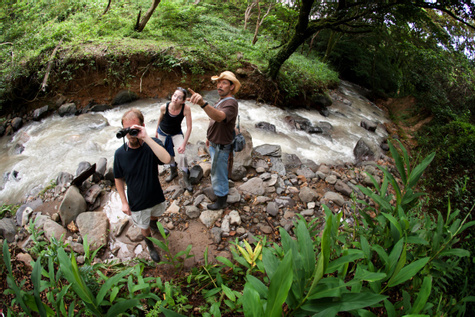
Don’t miss out on the night tours, as they were a fantastic way to see a lot of wildlife you never see during the day, including many species of frogs, snakes, and birds.
Costa Rica
From $1,432 per person
14 days · Arenal, Monteverde, Nosara
Couple
We thoroughly enjoyed our vacation relaxing at Nosara. After an adventurous jaunt in Arenal, this relaxing pace was just what we needed.

Costa Rica
From $1,721 per person
15 days · San Jose, Puerto Viejo de Limon, Arenal, Monteverde +1
Couple
Costa Rica is a beautiful country full of beautiful people. When talking about Costa Rica with my mom/travel partner, she said "Is that someplace people go?". After our first day there all her worries were alleviated by all of the wonderful and helpful people we met.

Costa Rica
From $2,302 per person
14 days · Arenal, Monteverde, Manuel Antonio
Couple
To celebrate our 25th wedding anniversary, we chose to visit Costa Rica. It was our first time visiting, but we fell in love with the place immediately. From Arenal, to Monteverde, to Manuel Antonio we’d come back again!

Costa Rica